
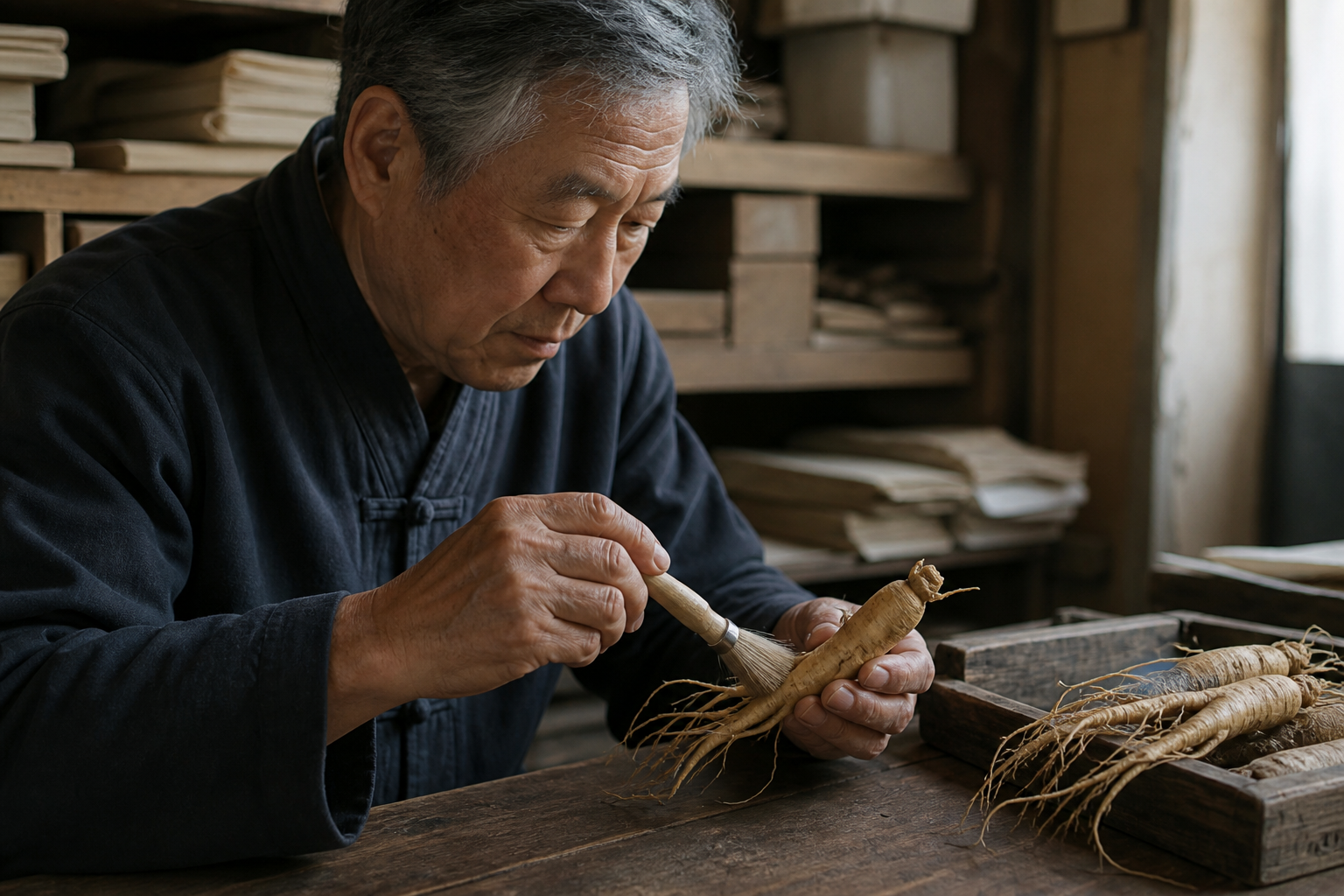
The Cochrane review of Panax ginseng for cognition in healthy people analyzed five trials with extractable data and concluded there is a lack of convincing evidence for a cognitive-enhancing effect. Acute single doses of the standardized G115 extract at 200–400 mg produce modest, inconsistently replicated effects on working memory and subjective calm within a few hours. Chronic dosing in people with subjective memory impairment or mild cognitive impairment looks more favorable, but that literature comes predominantly from Korean groups with ginseng-industry involvement. Two interactions matter more than the efficacy question: ginseng lowers postprandial glucose and it reduces INR in people on warfarin.
We’re not recommending a product on this page. None of the three formulas we have audited contains Panax ginseng, and we don’t force a product onto a page where it doesn’t belong. Start with the tier list — it shows which compounds have human trials behind them and which don’t.
See the tier list →What Panax ginseng is — and what it isn’t
Panax ginseng C.A. Meyer is the plant sold as Asian ginseng, Korean ginseng and, when steamed and dried, Korean red ginseng. Its putative actives are ginsenosides, a family of triterpene saponins. The most-studied preparation in Western trials is G115, an extract standardized to 4% ginsenosides and sold as Ginsana.
Two clarifications save a lot of confusion. First, Siberian “ginseng” is not ginseng. Eleutherococcus senticosus is a different plant in a different genus with a different chemistry, and evidence about one says nothing about the other. Second, American ginseng (Panax quinquefolius, often sold as the branded extract Cereboost) is a genuine Panax relative but has its own, much smaller literature — a handful of acute crossover trials at 100–400 mg reporting working-memory and mental-fatigue effects at one to six hours, with minimal chronic data and minimal independent replication.56
Acute and chronic are two different questions
Almost every disagreement about ginseng traces back to people arguing about different experiments. Taking one 200 mg dose and measuring reaction time two hours later is not the same study as taking 400 mg daily for twelve weeks and measuring memory. Ginseng behaves differently in each.
Acute. Single-dose G115 studies from the Reay, Scholey and Kennedy groups report modest effects on working memory and subjective calmness, alongside a glucose-modulating mechanism — one hypothesis being that the cognitive effect rides on changes in blood glucose availability during demanding tasks. These are interesting, small, and not consistently replicated.4
Chronic. This is where Cochrane looked, and where the answer is unfavorable in healthy people. Nine trials met inclusion criteria and five had extractable data; the review concluded there is “a lack of convincing evidence to show a cognitive enhancing effect of Panax ginseng in healthy participants.” Some improvement in aspects of cognition, behavior and quality of life was suggested but not established, and no serious adverse events were reported.1
The evidence, by population
| Evidence | Population | Preparation and dose | Design | Result |
|---|---|---|---|---|
| Cochrane CD007769 | Healthy participants | Mixed | Systematic review, 9 trials included, 5 analyzed | No convincing cognitive-enhancing effect |
| Recent meta-analyses | Subjective memory impairment, MCI, early AD | Mixed, incl. red ginseng | Meta-analysis | Small MMSE and ADAS-Cog improvements; Korean, industry-linked trial base |
| Acute G115 studies | Healthy adults | G115 200–400 mg, single dose | Crossover | Modest working memory and calmness; not consistently replicated |
| Korean red ginseng trials | Varied | 1–4.5 g/day powdered root | RCT | The basis of the impaired-population meta-analyses |
The meta-analyses in impaired populations are the strongest part of the case, and they need reading with the provenance attached. They report small improvements on the MMSE and ADAS-Cog in people with subjective memory impairment, mild cognitive impairment or early Alzheimer’s disease.2 They also draw predominantly on trials run by Korean research groups with ginseng-industry involvement, in a country where ginseng is a major agricultural export. That does not make the results wrong. It does mean the field is waiting for independent replication that has not arrived, which is the same structural problem saffron has in Iran and ashwagandha has in India.
The Alzheimer’s Drug Discovery Foundation’s independent rating reaches a similar place: a plausible compound with a thin, geographically concentrated evidence base.4
Where the effect is real and where it isn’t
Evidence tier: Weak to Moderate.
Who may have benefited: people with subjective memory impairment or mild cognitive impairment, in Korean trials. That is the honest population, and it is not the population buying ginseng for a productive afternoon.
Who has not been shown to benefit: healthy adults taking it daily for cognition. Cochrane is explicit about this, and no subsequent trial has overturned it.
If your interest is a few hours of steadier attention, the compound in this reference with the best-replicated acute evidence is not ginseng — it is L-theanine combined with caffeine, and even there the effects are on attention and reaction time, measured in hours.
Dosing at a glance
- G115 (4% ginsenosides), chronic: 200–400 mg/day.1
- G115, acute: 200–400 mg as a single dose.
- Korean red ginseng, powdered root: 1–4.5 g/day in the Korean trial literature.
Note the gap between a 200 mg standardized extract and 4.5 g of powdered root. They are not the same product and the ginsenoside content is not comparable unless the label states a standardization percentage. If it doesn’t, you cannot map the bottle onto any trial — the same problem covered in proprietary blends.
Safety and interactions
Ginseng is generally well tolerated, and the Cochrane review found no serious adverse events. The most common complaints are insomnia — by some distance the leading one — plus headache, gastrointestinal upset, nervousness, breast tenderness and, reported in the trial literature, vaginal bleeding. A published safety analysis of Panax ginseng randomized trials covers the profile in detail.3
Two interactions deserve to be named specifically, because both are documented rather than theoretical and both run in a direction people find counterintuitive.
⚠️ Talk to your prescriber first
Warfarin. Panax ginseng reduces INR — there are case reports and a controlled study, and this is one of the better-documented herb-warfarin interactions. Note the direction: the concern is reduced anticoagulation and therefore clot risk, which is the opposite of the bleeding risk that ginkgo and curcumin carry.7 Either way, the instruction is the same — clear it with the prescriber who manages your INR.
Diabetes medication. Ginseng lowers postprandial glucose. Combined with insulin or a sulfonylurea, that is additive hypoglycemia risk. American ginseng has the stronger glucose-lowering evidence of the two species.
The rest of the list, stated once:
- MAOIs (phenelzine) — case reports of headache, tremor and mania. Avoid the combination.
- Stimulants and caffeine — additive, and insomnia is already ginseng’s most common side effect.
- Blood pressure — ginseng may move it in either direction, so it is not a reliable addition for anyone whose BP is being actively managed.
- Possible estrogenic activity — caution in hormone-sensitive cancers.
- Pregnancy — avoid.
If you are on an antidepressant, the compound-by-compound picture is in nootropics and antidepressants. If you have surgery scheduled, botanicals including ginseng should stop at least two weeks beforehand — see supplements to stop before surgery.
How it’s sold
Ginseng is marketed on the word “adaptogen,” a category term with no agreed physiological definition, and on a long traditional-use history that is real and is not evidence of a cognitive effect. Both are ways of making a claim without making a testable one.
The commonest specific move is to cite the favorable meta-analyses in impaired populations on a page selling to healthy adults. The populations are different, the baseline is different, and the effect sizes reported are small changes on clinical rating scales, not the alertness a buyer is picturing.
Watch labels for the species. “Ginseng” on an ingredient panel can mean Panax ginseng, American ginseng, or Siberian eleuthero, and the three have separate literatures. Watch also for the standardization percentage; without it, the dose is uninterpretable.
Our verdict
For a healthy adult hoping to think more clearly, Panax ginseng has been tested and Cochrane’s answer was no convincing effect. That is a useful, publishable finding and it should be the headline.
The residual case — small acute effects, and a more favorable but geographically concentrated literature in memory-impaired populations — is not nothing, and it is not enough to recommend a daily habit. If you take warfarin, insulin or a sulfonylurea, the interaction questions come before the efficacy question. Against a daily multivitamin-mineral, which produced a positive and replicated cognitive result across the three COSMOS sub-studies in adults over 65, ginseng is a considerably weaker bet.89
What would change our mind
A pre-registered, adequately powered randomized trial of standardized ginseng in adults with subjective memory impairment, run outside Korea by a group with no ginseng-industry funding, over at least six months, with a cognitive primary endpoint. The favorable meta-analytic signal exists; what it lacks is an independent test. If one were run and replicated the effect, this page would change.
Frequently asked questions
Is Korean red ginseng better than regular ginseng?
Red ginseng is the same plant, steamed and dried, which changes the ginsenoside profile. Most of the favorable trials in memory-impaired populations used red ginseng at 1–4.5 g/day of powdered root, while most Western acute studies used the G115 standardized extract at 200–400 mg. No head-to-head trial establishes one as better for cognition.
Can I take ginseng with warfarin?
Not without your prescriber’s involvement. Ginseng has been shown to reduce INR, which means less anticoagulation than your dose is calibrated for. It is one of the better-documented herb-drug interactions in this whole category and it is not something to manage by feel.
Does ginseng help with fatigue rather than memory?
Subjective calmness and reduced mental fatigue show up in some acute studies, in healthy adults, within hours of a single dose. Those are self-reported measures in small crossover trials that have not been consistently replicated, so treat it as a possibility rather than an established effect.
How long does ginseng take to work?
The acute studies measured effects within one to six hours of a single dose. The chronic trials ran weeks to months. Since the chronic evidence in healthy people is the part Cochrane found unconvincing, a long self-experiment is unlikely to tell you anything a single dose wouldn’t.
Related reading
- Do nootropics actually work? An honest tier list
- Ginkgo biloba: two enormous trials, two failures
- L-theanine dosage: what was actually used in the studies
- Cognitive supplements to stop before surgery
- Nootropics and antidepressants: a compound-by-compound interaction guide
- The case against brain supplements
Sources
- Cochrane review CD007769 — Panax ginseng for cognition in healthy participants
- Meta-analysis of ginseng in cognitively impaired populations, Phytotherapy Research
- Safety analysis of Panax ginseng randomized controlled trials, Medicines
- Alzheimer’s Drug Discovery Foundation — Cognitive Vitality rating for Panax ginseng
- Review of American ginseng and human neurocognition, Nutritional Neuroscience (2025)
- American ginseng research review, Journal of Ginseng Research
- Bleeding-risk analysis of botanicals with antithrombotic therapy, PLOS ONE
- COSMOS-Mind, Alzheimer’s & Dementia
- COSMOS-Clinic and meta-analysis of the three COSMOS cognitive studies, AJCN
These statements have not been evaluated by the Food and Drug Administration. Nothing here is intended to diagnose, treat, cure or prevent any disease.
This article is information, not medical advice. Talk to a doctor or pharmacist about your own situation, especially if you take prescription medication.