
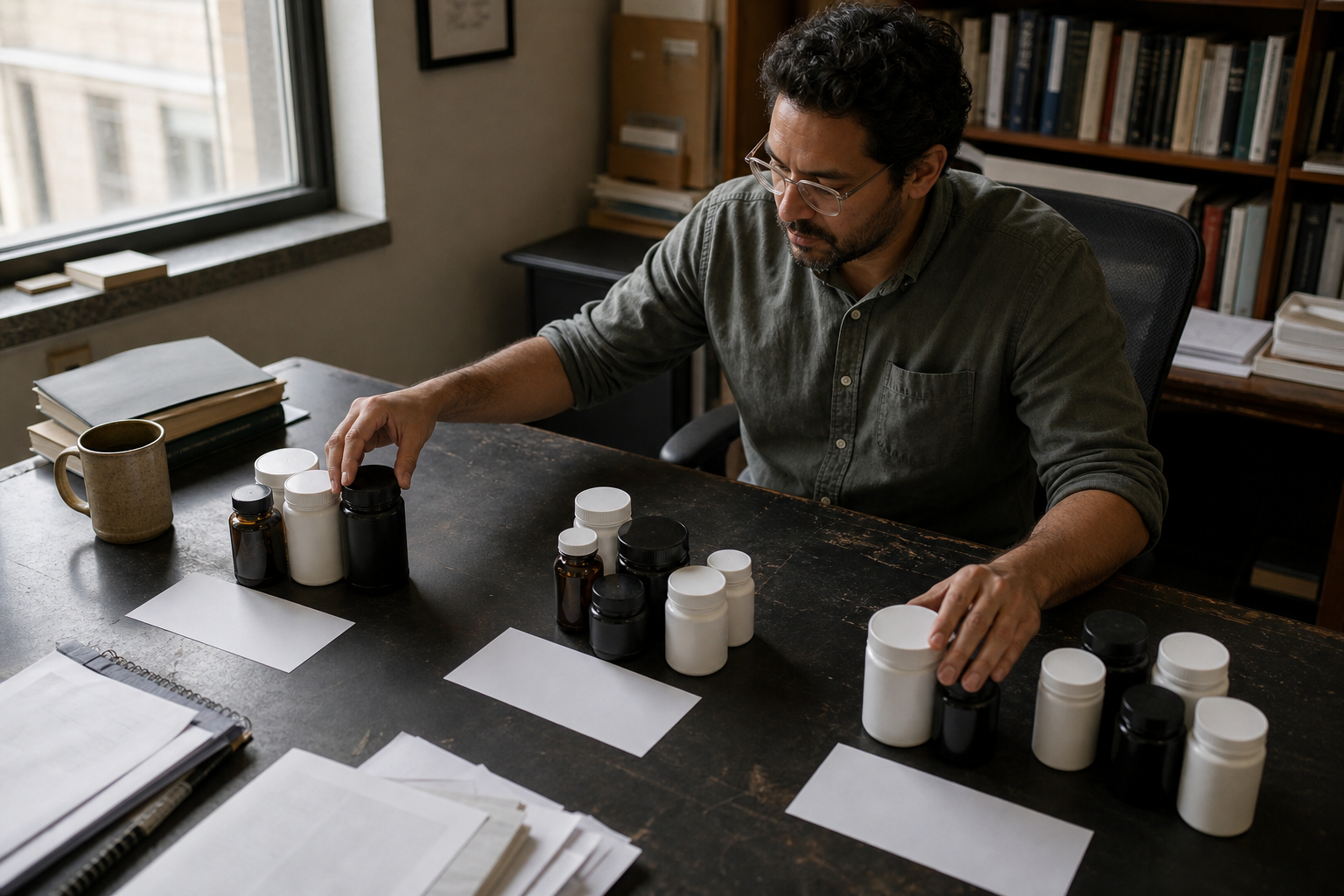
No compound in this reference earns a STRONG evidence rating for improving cognition in healthy adults — not one. The honest top of the field is MODERATE, and the single best-replicated positive result belongs to a plain daily multivitamin-mineral, which slowed measured cognitive aging in adults over 65 across three COSMOS sub-studies. Everything else that works, works in a defined population: older adults, people correcting a deficiency, people under acute stress, or people with diagnosed dementia. The tier table below gives all 40 compounds a rating, a one-line verdict, and the population where an effect was actually observed.
The claim
The nootropics category is sold on a simple promise: a capsule containing a mushroom, a root or a jellyfish protein will make a healthy brain work better than it currently does. Sharper recall, faster thinking, more hours of focus. The promise is usually attached to a mechanism — nerve growth factor, mitochondrial biogenesis, acetylcholine, cerebral blood flow — and the mechanism is usually real. What is missing is the step where the mechanism produces a measurable cognitive change in a person who is not already impaired.
This page is the answer to “do nootropics work” that we would want if we were the reader: every compound we track, with its evidence tier and the population the evidence came from. It is the reference the rest of our ingredient coverage hangs off, and the criteria behind it are set out in how we rate evidence.
Where the claim came from
Three separate sources feed the belief that these compounds work in healthy people, and none of them is a clinical trial in healthy people.
Preclinical work, read as if it were clinical. Lion’s mane is the clearest case. Hericenones and erinacines stimulate nerve growth factor in cell culture and in rodents. NGF is a large protein that does not cross the blood-brain barrier, and no study has shown that an oral mushroom extract raises NGF in a human brain. The mechanism is genuine. The inference is not. Magnesium L-threonate has the same shape: the entire premise comes from rodent work at MIT and Tsinghua, and no human study has shown that the threonate form raises human brain magnesium more than cheaper forms do.
Trials in impaired populations, quoted without the population. Citicoline’s better data are in vascular and age-related cognitive impairment. Alpha-GPC’s efficacy data come almost entirely from dementia trials, usually as an add-on to donepezil. Saffron’s striking donepezil-comparison result is in Iranian patients with mild-to-moderate Alzheimer’s. Each is a real finding about a specific group of patients. None of them is a finding about a healthy 34-year-old with a deadline.
The sales-page template. The direct-response version of this category follows a fixed structure: an origin story about one unusual root, mushroom or nerve; a misattributed institutional source; a proprietary blend at undisclosed and usually sub-clinical doses; six-bottle bulk pricing behind a 60-day refund guarantee; and “reviews” seeded across press-release newswires. A proprietary blend is the mechanically important part — it legally conceals per-ingredient doses, and a 500 mg blend of twelve botanicals cannot contain a working dose of any of them. Bacopa’s trials used 300–450 mg of a standardized extract on its own.
What the evidence actually shows
We use four tiers. STRONG means multiple RCTs or meta-analyses showing a consistent, clinically meaningful cognitive effect. MODERATE means some RCTs with positive but limited, mixed or population-specific effects. WEAK means mostly preclinical work, small studies, or inconsistent human data. INSUFFICIENT/NEGATIVE means well studied and largely failed, or essentially unstudied in humans.
The STRONG column is empty for healthy-adult cognition. That is the finding, and it does not have an asterisk.
| Compound | Evidence tier | Honest one-line verdict | Population where an effect was actually seen |
|---|---|---|---|
| Citicoline (CDP-choline) | Moderate | Best evidence in vascular and age-related impairment; healthy-adult data thin and often industry-funded | Older adults with age-associated memory impairment; vascular cognitive impairment. One trial found slight declines in high-baseline performers |
| Alpha-GPC | Moderate / Safety signal | MMSE mean difference 3.50 as monotherapy in dementia; a Korean cohort found a 43% higher 10-year stroke hazard78 | Patients with mild-to-moderate Alzheimer’s or vascular dementia, mostly at 1,200 mg/day alongside donepezil |
| Bacopa monnieri | Moderate | Real but small: Trail Making B shortened 17.9 ms, choice reaction time 10.6 ms, after ≥12 weeks5 | Healthy adults across a broad age range taking 300–450 mg of a standardized extract for 12 weeks or more |
| Lion’s mane | Weak | Seven small short trials, inconsistent; one found fewer words recalled than placebo in young adults6 | Possibly Japanese adults 50–80 with mild cognitive impairment, transiently — scores fell back after dosing stopped |
| Ginkgo biloba (EGb 761) | Moderate in dementia / Negative for prevention | 2026 Cochrane, 82 studies and 10,613 participants: modest variable 6-month benefit in dementia, little or no difference in MCI1 | People with diagnosed dementia, at 240 mg/day, over about six months. Two prevention trials in ~5,900 people found nothing |
| L-theanine | Moderate (acute only) | One robust finding: choice reaction time at hour 1, SMD −0.35. Not a memory agent2 | Healthy adults, roughly 0–2 hours after a 200 mg dose |
| Caffeine + L-theanine | Moderate (acute only) | The best-replicated acute combination here: attention-switching accuracy SMD 0.33, digit vigilance accuracy SMD 0.20 at hour 22 | Healthy adults for a few hours; also acutely sleep-deprived young adults |
| Omega-3 (DHA/EPA) | Moderate in subgroups / Negative for prevention | 500–2,000 mg/day for 6–24 months produced no cognitive improvement in healthy older adults or in established Alzheimer’s13 | People with mild cognitive impairment, and people with low baseline omega-3 intake |
| Creatine monohydrate | Moderate | Memory SMD 0.29–0.31 overall; EFSA assessed the cognition claim in 2024 and rejected it34 | Adults aged 66–76 (SMD 0.88); vegetarians; sleep-deprived and stressed people. Ages 11–31: SMD 0.03, effectively zero |
| Rhodiola rosea | Weak | Systematic review of 11 trials: evidence for physical and mental fatigue is limited and contradictory | Possibly shift workers and students under exam stress. Not established for cognition itself |
| Ashwagandha | Moderate / Liver signal | 2026 meta-analysis of 20 RCTs: memory SMD 0.52 — but 14 of 20 trials ran in India, many with manufacturer involvement. LiverTox likelihood score B910 | Generally healthy adults 18–75, mostly in India, over about 8 weeks; largest effects on stress and anxiety measures |
| Phosphatidylserine | Moderate (bovine, historical) / Weak (soy) | The soy form did not replicate the old bovine results; FDA permits only a qualified claim whose required wording says the evidence is very limited and preliminary | Adults over about 50 with age-associated memory impairment, particularly those with the poorest baseline scores |
| Huperzine A | Moderate in Chinese trials / discuss, never recommend | A genuine acetylcholinesterase inhibitor — the same class as donepezil. Cochrane: evidence inadequate to make any recommendation11 | Chinese patients with Alzheimer’s or vascular dementia, in trials whose methodological quality Cochrane rated as not high. No benefit in healthy military personnel |
| Vinpocetine | Do not recommend | FDA’s position is that it does not meet the statutory definition of a dietary ingredient; a June 2019 warning advised women of childbearing age to avoid it entirely20 | None. Cognitive-enhancement evidence in healthy people is effectively absent |
| Panax ginseng | Weak–Moderate | Cochrane: a lack of convincing evidence of a cognitive-enhancing effect in healthy participants12 | Possibly people with subjective memory impairment or MCI, in Korean trials with ginseng-industry involvement |
| American ginseng | Weak | A small set of acute crossover trials, mostly from one university group and partly funded by the branded extract’s owner | Healthy young adults, 1–6 hours after 100–400 mg. Chronic-dosing evidence is minimal |
| Curcumin | Weak–Moderate | One 18-month bioavailable-curcumin trial in 40 people found verbal memory and attention benefits; it has not been replicated, and Alzheimer’s trials were null | Non-demented adults aged 50–90, at a single site, using a bioavailability-enhanced formulation |
| Resveratrol | Weak | Cerebral blood flow changes reproduce; cognitive benefit does not. A 52-week Alzheimer’s trial found greater brain volume loss in the resveratrol group | Postmenopausal women, in one research group’s work. Nobody else, reliably |
| Acetyl-L-carnitine | Moderate (old data) | A positive 2003 meta-analysis, but the trials are 20–35 years old, small, and largely sponsored by one manufacturer | Adults with MCI and mild Alzheimer’s, over three months or more |
| Magnesium L-threonate | Weak | Rodent-derived premise plus a handful of small, mostly manufacturer-linked human trials; ~8% elemental magnesium at 5–10× the price of glycinate | Older adults with cognitive impairment in one 44-person trial; possibly people with poor sleep |
| Vitamin B12 | Moderate in deficiency / Negative when replete | Deficiency causes real and sometimes reversible cognitive impairment. Supplementing replete people does nothing | People who are actually deficient: adults over 50, vegans, people on metformin or long-term acid suppression, pernicious anaemia, post-bariatric surgery |
| Vitamin B6 | Weak / Negative alone | No demonstrated cognitive benefit alone; chronic high doses cause sensory peripheral neuropathy | None on its own. Relevant only as one of three vitamins in a homocysteine-lowering regimen |
| Folate (B9) | Moderate in a narrow subgroup | A meta-analysis of 11 trials in ~22,000 people found no effect on cognitive aging; VITACOG slowed brain atrophy by ~30% in a selected group14 | Adults with MCI plus elevated homocysteine plus adequate omega-3 status. Not unselected older adults |
| Vitamin D | Insufficient/negative for cognition | Strong observational link, null trials: VitaMIND found no cognitive benefit, the Finnish D trial found no reduction in diagnosed dementia15 | Nobody, for cognition, in randomized trials. Correcting real deficiency remains worthwhile for other reasons |
| Saffron | Moderate in Alzheimer’s | 30 mg/day performed comparably to donepezil 10 mg/day on ADAS-Cog over 22 weeks — never independently replicated outside Iran | Iranian adults with mild-to-moderate Alzheimer’s; also adults with mild-to-moderate depression |
| PQQ | Weak | Two or three small Japanese trials with mixed results, industry-affiliated; independent commentary describes little effect on brain function in adults | No clearly defined population. EU novel-food intake limit is 20 mg/day |
| CoQ10 | Insufficient/negative | Eight human cognitive RCTs with mixed results; the NIH high-dose Parkinson’s trial was terminated for futility16 | None for cognition. Its defensible use case is statin-associated muscle symptoms, which is not a cognitive claim |
| NAD+ precursors (NR, NMN) | Weak | Blood NAD+ rises reliably; cognition does not. Multiple trials in healthy older adults show NAD+ elevation without functional benefit | None demonstrated. NMN’s US legal status changed in September 2025 and remains contestable |
| Taurine | Weak | Few, short, inconsistent trials; most “alertness” data come from energy drinks where 1,000 mg taurine arrives with 80 mg caffeine and 27 g sugar | None established for cognition |
| L-tyrosine | Moderate under stress only | Replenishes cognitive resources when neurotransmitter function is temporarily depleted; does nothing in the absence of that demand | Healthy young and middle-aged adults under cold, noise, sleep loss or multitasking load. Acutely impaired response inhibition in healthy older adults |
| Sage | Weak–Moderate | Real cholinesterase inhibition and real acute trials, but tiny and rarely replicated | 42 patients with mild-to-moderate Alzheimer’s over four months; healthy older volunteers acutely |
| Gotu kola | Insufficient/negative | Meta-analysis of 11 RCTs: no significant difference from placebo on any cognitive domain. Three hepatitis case reports | None. Its legitimate evidence is in venous insufficiency and wound healing |
| Noopept (omberacetam) | Do not recommend | A Russian prescription drug, not a lawful US dietary ingredient; no independently replicated human RCT | None outside Russian-language trials that are unavailable for independent scrutiny |
| Racetams | Do not recommend | Not lawful US dietary ingredients; FDA has issued warning letters on that basis | Piracetam has a genuine narrow use in cortical myoclonus. Not cognitive enhancement in healthy adults |
| Caffeine (alone) | Moderate–strong for alertness / Negative for memory | Among the most replicated findings in psychopharmacology — for vigilance. In habitual users much of the apparent benefit is reversal of overnight withdrawal | Everyone, for sustained attention and reaction time. Nobody, for memory consolidation or learning |
| Daily multivitamin-mineral | Moderate, approaching strong in 65+ | COSMOS-Mind: cognitive aging slowed by roughly 60%, about 1.8 years over 3 years. COSMOS-Web: memory benefit at 1 year sustained through 31718 | Adults over 65 in a large, placebo-controlled, multi-year trial — larger benefits in those with cardiovascular disease history |
| Cocoa flavanols | Insufficient/negative | COSMOS tested this properly at 500 mg/day for 3 years in more than 5,700 people and found no cognitive effect17 | None. A possible signal survived only in the subgroup with low baseline dietary flavanol intake |
| Apoaequorin (Prevagen) | Insufficient/negative | A protein taken orally and therefore digested; in December 2024 a federal court ordered the marketer to stop the deceptive memory claims19 | None |
| Phenibut | Do not recommend | FDA states it does not meet the statutory definition of a dietary ingredient; dependence and a severe withdrawal syndrome are well documented | None |
| Uridine monophosphate | Weak | Human data exist almost only inside the Souvenaid medical-food matrix, not as a standalone supplement | Very early or prodromal Alzheimer’s, within the full matrix. No adequate standalone trial in healthy adults exists |
The four entries that survive scrutiny
A daily multivitamin-mineral is the strongest result in the table and the least exciting. COSMOS randomized thousands of older adults for three years, tested them by telephone, by web and in person, and found a consistent modest slowing of cognitive aging — larger in participants with a cardiovascular history, which fits a “correcting marginal micronutrient insufficiency” explanation rather than a pharmacological one. It cost a few cents a day and it outranks every proprietary botanical blend here.
Caffeine with L-theanine is the most reliable acute effect: attention and task-switching accuracy for a few hours, with theanine taking some of the edge off caffeine’s jitteriness. Creatine has a real memory signal concentrated almost entirely in people aged 66–76, in vegetarians and in the sleep-deprived, which is why EFSA still declined the claim in 2024. Bacopa produces a small, measurable change in attentional speed — after twelve weeks, at 300–450 mg of a standardized extract, which is more than most blends contain in total. To see how one product’s label measures up against figures like these, read our MemoryFuel review.
Two safety signals that outweigh the efficacy data
⚠️ Talk to your prescriber first
A South Korean national database study of more than 12 million adults aged 50+, comparing 108,877 alpha-GPC users against non-users over ten years, found adjusted hazard ratios of 1.43 for total stroke, 1.34 for ischemic and 1.37 for hemorrhagic, with a dose-response gradient. It is observational and confounding by indication is a genuine concern — people prescribed alpha-GPC in Korea already have cognitive complaints and higher vascular risk — and a separate Korean analysis suggested delayed dementia conversion in users. Both belong in the same sentence. If you have cerebrovascular disease, a prior stroke or TIA, uncontrolled hypertension, or take an anticoagulant, this is a conversation for your doctor before it is a purchase.
⚠️ Ashwagandha and the liver
NIH LiverTox assigns ashwagandha a likelihood score of B — a likely cause of clinically apparent liver injury, with roughly 23 published cases as of the 2024 update. The pattern is predominantly cholestatic or mixed, with jaundice and itching, and latency is typically two to twelve weeks after starting. Most cases resolved within one to four months of stopping; rare cases required transplant. Denmark and Iceland have restricted or advised against these products. Stop and see a doctor if you develop jaundice, dark urine, pale stool, right-upper-quadrant pain, unexplained fatigue or itching.
Why the claim persists
Deficiency correction is sold as universal enhancement. B12 is the cleanest example. Correcting a real deficiency can reverse confusion, memory problems and neuropathy, and that is medically important. Giving B12 to someone who is already replete does nothing. A label can be entirely honest about the first fact while a sales page relies on you assuming the second.
Caffeine makes the whole category feel plausible. Most people have direct personal evidence that a chemical can change how their brain feels within thirty minutes. That experience transfers, unearned, to a capsule of powdered mushroom. It also cuts the other way: in habitual coffee drinkers a good deal of the morning lift is the reversal of overnight withdrawal rather than a net gain over baseline.
The literature is small, short and often sponsored. Fourteen of the twenty ashwagandha trials ran in India, many with manufacturer involvement. Nearly all positive huperzine A data come from China. The magnesium L-threonate trials are linked to the licensor of the branded form. None of this makes a result false; all of it changes how much weight one result can carry, and the pattern across this file is that independent replication is the step that usually does not happen.
Community reports — not trial data
Forum threads about stacks tend to split into two recurring patterns: people describing a strong first week that fades, and people who cannot separate the stack from the sleep, the caffeine or the new job that started the same month. Both are worth reading and neither is evidence. Uncontrolled self-experiments run without a placebo, without blinding and without a baseline measurement mostly measure expectation.
What to do instead
Start with the variables that have larger effects than anything in the table. Caffeine’s half-life is around five to six hours, so an afternoon cup measurably degrades sleep architecture — and sleep is the single most powerful cognitive variable there is. Our methods pages cover the non-supplement levers in more detail, and the brain fog hub covers the situations where fog is a signal rather than a nuisance.
- Check status before you supplement. If you are over 50, vegan, on metformin, or on long-term acid suppression, B12 status is worth asking your doctor about. It is a blood test, not a guess.
- If you are over 65, a plain multivitamin has the best trial behind it — check its B6 content and, if you take levothyroxine, separate it from iron and calcium by four hours.
- Buy single ingredients at studied doses, not blends. A proprietary blend cannot tell you what you took, which means it cannot tell you what worked.
- Give it the duration the trials used. Bacopa needs twelve weeks. Anything sold as fast-acting bacopa is misrepresenting the mechanism.
- Tell your prescriber. Ginkgo and anticoagulants, ashwagandha and thyroid medication, huperzine A and donepezil, rhodiola and CYP3A4 substrates — these are the interactions that matter, and they are covered across our guides.
What would change our mind
A preregistered, independently funded randomized trial of at least a thousand healthy adults, running twelve months or more, with a single named compound at a disclosed dose and a prespecified primary cognitive endpoint, reporting a benefit that survives its own sensitivity analysis. That is the study that would move any row in this table to STRONG. COSMOS shows it can be done — it is the shape of trial the multivitamin row rests on. No botanical in this category has one.
Frequently asked questions
Is there any nootropic with strong evidence in healthy adults?
No. Caffeine comes closest, and only for alertness and vigilance rather than memory or learning. Every other MODERATE rating in the table is attached to a specific population — older adults, deficient people, people under acute stress, or patients with a diagnosis.
Why does the multivitamin outrank the expensive botanicals?
Because it was tested properly. COSMOS randomized thousands of people for three years with placebo control and independent analysis, and reported consistent findings across three sub-studies. Most botanical trials in this field enrol 30 to 100 people for 8 to 12 weeks, and the replication step usually does not happen.
Do nootropic stacks work better than single ingredients?
There is one combination with replicated acute human data — caffeine with L-theanine. Beyond that, multi-ingredient blends are not tested as blends, and a proprietary blend conceals the per-ingredient doses, so there is usually no way to know whether any component reached a studied amount. Our NeuroPrime review shows what that looks like on a nine-botanical formula with no per-ingredient doses.
What does “MODERATE” actually mean in practice?
It means some randomized trials found positive effects, and those effects were limited, mixed, or confined to one population. Creatine’s memory effect is real and its standardized mean difference is 0.29 — small, and close to zero in people under 31. MODERATE is not a synonym for “works”.
Are any of these actually illegal to sell?
FDA’s position is that vinpocetine, phenibut, noopept and the racetams do not meet the statutory definition of a dietary ingredient, and warning letters have been issued on that basis20. Products containing them are treated as adulterated or misbranded.
Related reading
- How we rate evidence — the tier definitions used above
- Nootropics — the individual ingredient pages
- Brain fog — causes, and when it is worth seeing a doctor
- Start here — what this site is for
- Editorial policy — how we decide what to publish
Sources
- Cochrane review: Ginkgo biloba for cognitive impairment and dementia (2026)
- Systematic review and meta-analysis of L-theanine and theanine + caffeine, Nutrition Reviews 2025
- Prokopidis et al., creatine supplementation and cognition, Nutrition Reviews 2023
- EFSA scientific opinion on creatine and cognitive function (2024)
- Kongkeaw et al., meta-analysis of Bacopa monnieri randomized controlled trials, J Ethnopharmacol 2014
- Cognitive Vitality: Lion’s mane rating (Alzheimer’s Drug Discovery Foundation)
- Sagaro et al., systematic review and meta-analysis of choline alfoscerate, J Alzheimers Dis
- Association of L-alpha-glycerylphosphorylcholine with subsequent stroke risk (Korean national cohort)
- Systematic review and meta-analysis of ashwagandha RCTs, Frontiers in Pharmacology 2026
- NIH LiverTox: Ashwagandha
- Cochrane: insufficient evidence on the effects of huperzine A in Alzheimer’s disease
- Cochrane: no convincing evidence of a cognitive-enhancing effect of Panax ginseng
- NIH Office of Dietary Supplements: Omega-3 fatty acids
- Clarke et al., homocysteine-lowering B vitamins and cognitive aging, Am J Clin Nutr 2014
- VitaMIND randomized trial: vitamin D and cognition, JAMDA 2025
- QE3: high-dose CoQ10 in early Parkinson’s disease, JAMA Neurology 2014
- COSMOS-Mind: multivitamin and cocoa extract effects on cognition
- COSMOS-Clinic and meta-analysis of the three COSMOS cognitive studies, Am J Clin Nutr
- FTC statement on its win in the lawsuit against the makers of Prevagen (December 2024)
- FDA: Vinpocetine in dietary supplements
These statements have not been evaluated by the Food and Drug Administration. Nothing here is intended to diagnose, treat, cure or prevent any disease.
This article is information, not medical advice. Talk to a doctor or pharmacist about your own situation, especially if you take prescription medication.