
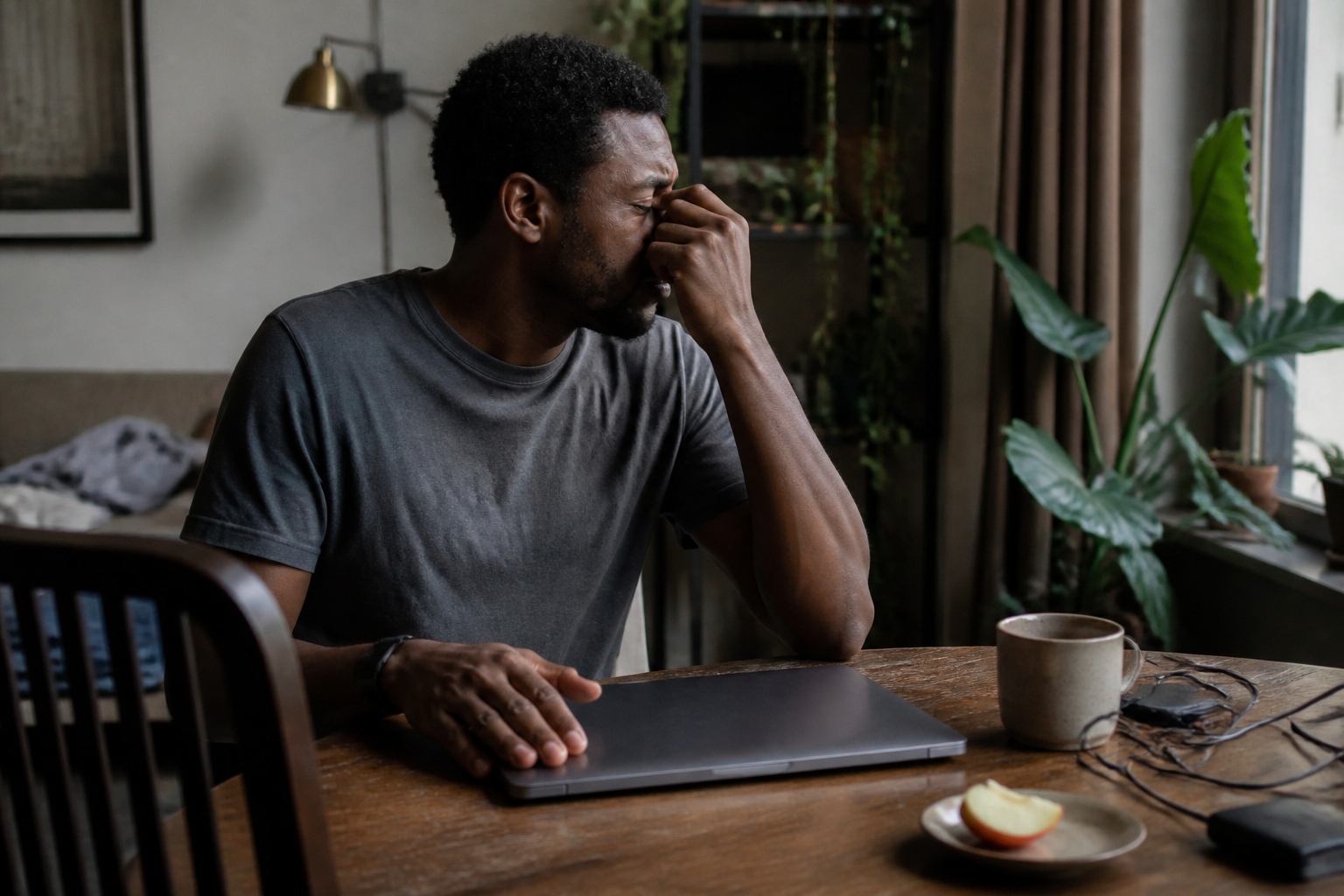
Remote work removes three things that used to regulate your brain without your involvement: a fixed wake time, a large dose of morning daylight, and physical movement between places. Add back-to-back video calls and all-day access to a coffee machine, and the result is a predictable afternoon flatness that most people interpret as a memory problem. It is almost always a circadian and sleep problem wearing a memory problem’s clothes — which is good news, because those are the two variables with the largest measured effects on cognition and neither of them costs anything.
If you are going to buy something anyway, this is the conservative end of the category: creatine monohydrate 5,000 mg, L-theanine 200 mg, choline bitartrate 300 mg, magnesium glycinate 300 mg, vitamin D3 2,000 IU and vitamin B12 25 mcg, per the brand store’s own panel. Two things before you click: creatine’s small memory effect sits in adults 66–76, vegetarians and the sleep-deprived rather than well-rested younger omnivores, and the ClickBank funnel charges $69 a bottle while Nutraville’s own store sells it at $59, or $49 on subscription. It does nothing about the light, sleep and movement problems below, which is where the effect sizes are.
We earn a commission if you buy through this link. It costs you nothing extra and it does not change what we write.
Full MemoryFuel review: doses, price, red flags →
Check the current price →What’s actually going on
An office commute is an accidental intervention. It forces a wake time, delivers a large dose of outdoor light within an hour or two of waking, and involves walking. None of those were chosen for their cognitive benefits, and all three disappear the day you start working from a bedroom.
Light is the biggest single loss. A bright indoor room sits at a few hundred lux; an overcast morning outdoors is ten to twenty times that. Light is the primary input keeping the circadian system anchored, and that anchor determines when you get sleepy, how consolidated your sleep is, and how alert you are the next morning. A trial in college students found morning bright light improved nocturnal sleep and next-morning alertness.3 The honest counterweight is a Cochrane review of workplace lighting: small, heterogeneous, low-certainty.2 The direction is consistent; the size of it in your apartment is not something anyone has measured.
Sleep timing drifts, then sleep duration follows. With no commute, wake time slides later on some days and not others, and bedtime follows the evening rather than the alarm. The cost is not felt as sleepiness. In the standard chronic sleep-restriction experiment, adults held to six hours a night accumulated deficits in sustained attention over two weeks while their subjective sleepiness ratings plateaued.1 That gap between how you feel and how you perform is what people describe as brain fog.
Video calls are cognitively expensive, though the evidence is thinner than the discourse. The most-cited account is Jeremy Bailenson’s nonverbal-overload argument — excessive close-up eye contact, constant self-view, reduced mobility, and the work of reading nonverbal signals through a small rectangle.4 Be precise about what that is: a theoretical argument, published as one, not an experiment. The follow-on work is a validated self-report scale.5 Self-report is real and is not the same as a measured cognitive decrement.
Caffeine drifts too. Nobody brings a 3pm coffee to a meeting room the way they pour one at home. Caffeine’s half-life is roughly five to six hours, and longer with oral contraceptives, pregnancy, liver disease or fluvoxamine. An afternoon cup is still measurably present at bedtime, where it degrades sleep architecture — which loops back into the first two paragraphs.
One more mechanism gets raised often, and we will label it honestly: a closed home office accumulates CO2, and there is a literature on indoor air quality and decision-making that we have not verified against primary sources for this page. Treat it as a hypothesis, not a finding.
How to tell it’s this and not something else
- It tracks the work week — worse by Thursday, better on a Saturday spent outdoors, largely absent on holiday.
- It responds within days. A fixed alarm and two mornings outdoors make a difference by the third or fourth day. Nothing structural improves that fast.
- It is worse on heavy-meeting days and better on days with long uninterrupted blocks, regardless of output.
- The complaint is attention, not memory. Rereading the same paragraph, drifting mid-sentence. A genuine memory concern sounds like forgetting events, not losing focus.
If it does not have that shape — if it is constant, progressive, present on holiday, or accompanied by anything on the red-flag list — then stop optimizing your desk and see a clinician. And if you have already been tested and everything came back normal, that situation has its own page.
What helps, in order of evidence strength
This order is not a rhetorical device. The interventions at the top have effect sizes the supplement industry has never come close to producing.
- 1. Protect sleep duration, then timing. A fixed wake time seven days a week and an honest count of hours in bed. Six-hour nights produce attention deficits you will not feel accumulating.1 Everything below this line is smaller; if you are running a debt, what recovers and what doesn’t is the better page.
- 2. Get outdoor light within an hour or two of waking. Ten to thirty minutes, outside, not through a window — the cheapest substitute for the commute you deleted.3 A light box is reasonable in a northern winter; daylight is stronger and free.
- 3. Set a caffeine cut-off. With a five-to-six-hour half-life, nothing after early afternoon if you sleep at eleven. Caffeine improves vigilance and reaction time; it does not improve memory or learning, and in habitual drinkers much of the felt benefit is reversal of overnight withdrawal.
- 4. Move the meal, not just the food. A large lunch reliably produces an early-afternoon dip — see the postprandial crash. The 3pm crash also has a circadian component that exists whether or not you ate.
- 5. Walk. Exercise has the strongest evidence of anything in this field and nobody sells it, which is its own story. A walk delivers light and a task boundary at the same time.
- 6. Redesign the calendar. Audio-only where the camera adds nothing, gaps between calls, no meeting straight after lunch. The evidence is self-report rather than performance measurement,5 so treat it as a cheap experiment, not a proven intervention.
- 7. Only then, supplements — and with modest expectations. See below.
On the last point, the whole honest picture is short. Caffeine plus L-theanine is the best-replicated acute combination here: a 2025 meta-analysis found digit vigilance accuracy improved with a standardized mean difference of 0.20 (95% CI 0.02–0.38) and attention-switching accuracy 0.33 (95% CI 0.13–0.54) at hour two, in trials using a median of roughly 82 mg theanine with 89 mg caffeine.6 A 2025 crossover trial found the high-dose version improved selective attention in acutely sleep-deprived young adults7 — which tells you what it is, a partial patch over a sleep problem. Creatine is the other compound with a genuine meta-analysis: pooled memory effect 0.29, but 0.88 in adults aged 66–76 and essentially zero (0.03) in those aged 11–31,9 with EFSA rejecting the cognition claim in 2024 as not established.11 For a well-rested omnivore in their thirties, the honest expectation is nothing.
What doesn’t help (but gets sold to you anyway)
- Ginkgo biloba. Two enormous prevention trials, two failures — the detail is worth reading once.
- Anything sold as a proprietary blend. A 500 mg “focus blend” of twelve ingredients cannot contain a working dose of any of them; here is how the trick works.
- Brain training apps, for transfer to actual work. The FTC has opinions, and they are on the record.
- Formulas built on our red-flag list. A label carrying huperzine A or vinpocetine tells you about the formulator, not about your afternoon.
- The stack, versus the boring option. The only large, replicated positive cognitive result in this field came from a plain daily multivitamin-mineral in adults over 651213 — see multivitamin vs nootropic stack.
When this warrants a doctor
Anything that breaks the pattern deserves a clinician rather than a routine change. Book an appointment if the fog is constant rather than cyclical, worsening over months, present through a genuine holiday, or accompanied by any of the following.
- Forgetting events rather than losing focus, or word-finding difficulty other people notice
- New headaches, visual changes, numbness, weakness or difficulty with coordination
- Unintended weight change, persistent low mood, or loss of interest in things you used to want
- Loud snoring, witnessed pauses in breathing, or waking unrefreshed after adequate hours — sleep apnea is common, treatable, and often mistaken for burnout
- Any new prescription that started around the same time as the fog
The full list is here; the broader map of what the term covers is at our brain fog hub.
What would change our mind
A randomized trial in remote workers — morning outdoor light and a fixed wake time versus usual routine, with objective cognitive testing rather than self-report, over at least eight weeks. Nobody has run it, so the ordering above is inferred from the sleep and circadian literature rather than tested in this population. If the light component did nothing once wake time was fixed, we would demote it here and say why.
Frequently asked questions
Why do I feel worse working from home than I did in an office?
The office was supplying structure you did not know you were buying: a forced wake time, a large morning light dose, walking, and natural breaks between conversations. Remote work removes all four at once. Reinstate them deliberately rather than looking for something purchasable that the office had.
Is Zoom fatigue a real measured effect or a media phenomenon?
It is real as a reported experience, with a validated self-report scale behind it. What it lacks is a body of work showing measured cognitive decrement attributable to videoconferencing specifically rather than to meeting load in general. The leading mechanistic account is explicitly a theoretical argument, and its author says so.
Does a standing desk help with brain fog?
We have found no trial evidence that standing while working improves cognitive performance, and we are not going to invent any. What has evidence behind it is exercise, which is not the same as standing still.
Related reading
- Brain fog — the category hub
- When Brain Fog Is a Red Flag: Symptoms That Warrant a Doctor
- Sleep Debt and Brain Fog: What Recovers and What Doesn’t
- The 3pm Crash: Why Afternoon Brain Fog Happens
- Morning Brain Fog and Sleep Inertia
- Exercise and Memory: The Strongest Intervention Nobody Sells
Sources
- Van Dongen et al., The cumulative cost of additional wakefulness, Sleep (2003)
- Workplace lighting for improving alertness and mood in daytime workers — Cochrane review
- Morning bright light improves nocturnal sleep and next-morning alertness among college students
- Bailenson, Nonverbal Overload: A Theoretical Argument for the Causes of Zoom Fatigue (2021)
- Fauville et al., Zoom Exhaustion & Fatigue Scale
- L-theanine and caffeine systematic review and meta-analysis, Nutrition Reviews (2025)
- Theanine and caffeine in acutely sleep-deprived young adults, British Journal of Nutrition (2025)
- L-theanine trial evidence — PubMed Central record
- Prokopidis et al., Creatine supplementation and cognition meta-analysis, Nutrition Reviews (2023)
- Xu et al., Creatine and cognitive function, Frontiers in Nutrition (2024)
- EFSA opinion rejecting a creatine and cognitive function health claim (2024)
- COSMOS-Mind: multivitamin supplementation and cognition, Alzheimer’s & Dementia
- COSMOS-Clinic and meta-analysis of the three COSMOS cognitive studies, AJCN
These statements have not been evaluated by the Food and Drug Administration. Nothing here is intended to diagnose, treat, cure or prevent any disease.
This article is information, not medical advice. Talk to a doctor or pharmacist about your own situation, especially if you take prescription medication.