
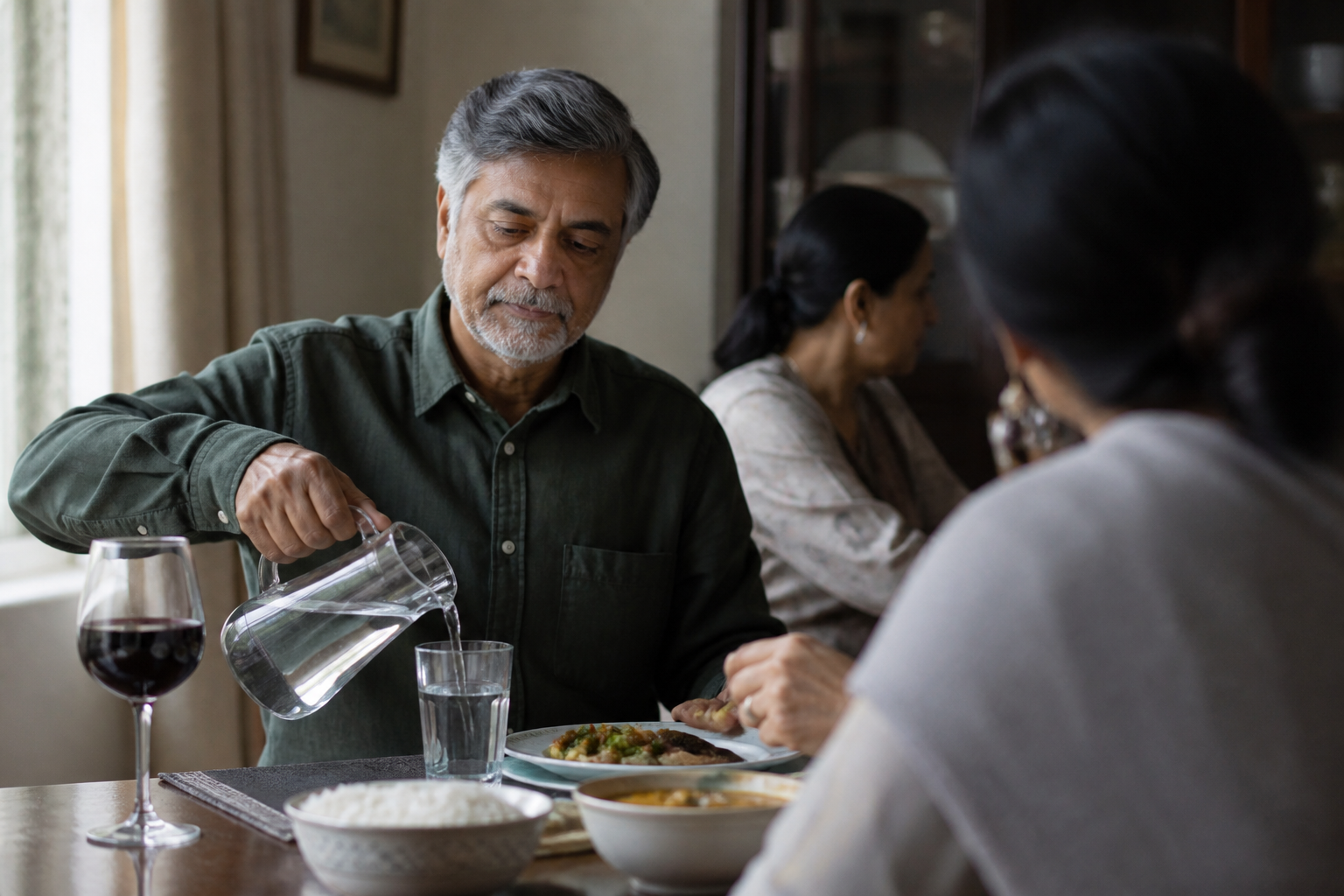
Alcohol is a sedative for the first half of the night and a stimulant for the second, so a few drinks buy fast sleep onset and then pay for it with fragmented, arousal-heavy sleep before morning. The next day’s fog is largely that sleep damage plus hangover itself — and hangover impairs attention and decision-making at a blood alcohol concentration of zero, peaking as the last of the alcohol clears and lasting 24 hours or longer. The second day, when people report it, is best explained as unpaid sleep debt rather than as anything still circulating: the measured hangover literature stops at around a day.
We’re not recommending a product on this page. Nothing in our tier list has been tested against post-drinking cognitive fog, and a supplement sold for that is being sold on a mechanism story. Start with the tier list — it shows which compounds have human trials behind them and which don’t.
See the tier list →What’s actually going on
The night splits in two. In the first half, alcohol shortens the time it takes to fall asleep and suppresses REM. In the second half, as blood alcohol falls, the picture inverts: REM rebounds, arousals increase, and sleep becomes fragmented. The review literature on alcohol and normal sleep describes exactly this biphasic pattern, and it is the reason a nightcap feels like it helped while the night as a whole got worse.2
Your autonomic nervous system stays busy. A 2022 study examining alcohol’s effects on sleep and nocturnal heart rate found that the physiological disruption tracks intoxication and relates to morning-after effects — which is a useful corrective to the idea that you slept eight hours and should therefore be fine.3 Hours in bed and sleep obtained are different measurements, and alcohol widens the gap between them.
What that costs you specifically. Here the evidence is more precise than most people expect. Ethanol taken just before sleep onset impaired memory for procedural tasks but not declarative ones.4 That is a narrow finding and worth reading narrowly: it is about a particular kind of overnight consolidation, in a particular design, not a general statement that drinking erases what you learned.
Hangover is its own thing, and it is cognitive. The NIAAA’s account is direct: during a hangover, attention, decision-making and muscle coordination can all be impaired, symptoms peak when blood alcohol returns to about zero, and they can last 24 hours or longer. The contributing factors it lists are mild dehydration, disrupted sleep, gastrointestinal irritation, inflammation, exposure to acetaldehyde, and a mini-withdrawal as the brain readjusts.1 Note the order and the plurality. Dehydration is on the list; it is one of six items, not the explanation.
So why does the second day feel bad? There is no measured 48-hour hangover in the literature we can point you at, and we are not going to invent one. The reasoning that fits: you lost a substantial amount of real sleep, one recovery night does not fully repay that, and the cost of accumulated sleep restriction shows up as degraded sustained attention that people consistently underestimate in themselves.6 If your Sunday is foggy after a Friday night, the most likely culprit is two nights of poor sleep, not residual anything. This is labelled as reasoning, not as a finding.
⚠️ A concern worth stating once
Everything above describes occasional drinking in people without alcohol dependence. Sustained heavy use produces a different and more entrenched pattern of sleep disturbance that persists into abstinence, and that is a clinical situation rather than a lifestyle one.5 Do not read this page as reassurance about heavy or daily drinking, and do not stop abruptly after sustained heavy use without medical advice — withdrawal can be dangerous.
How to tell it’s this and not something else
- It has a start date. The fog begins the morning after a specific evening, not gradually over months.
- It scales with the amount and with how late you drank. Two glasses at seven behaves differently from six at midnight, even for the same total.
- It resolves. Give it two nights of protected sleep and it should be gone. If it is not, that is the useful signal.
- You have the other hangover symptoms too — headache, thirst, light and sound sensitivity, irritability. Fog on its own, with no other hangover features, is more likely to be about sleep than about alcohol.
If the fog persists between drinking occasions, or is present on weeks when you did not drink at all, this page is not your answer. Start with the symptoms that warrant a doctor, and if you have already been investigated and everything came back clear, that has its own page.
What helps, in order of evidence strength
The ordering here follows the size of the underlying effect, not what is easiest to sell.
- 1. Sleep, and specifically the second night. The first recovery night after a heavy one is rarely enough. Hold a fixed wake time and get a full night on night two rather than sleeping until noon, which pushes the following night later and extends the problem. What does and doesn’t recover is covered in sleep debt and brain fog.
- 2. Stop drinking earlier, not necessarily less. The mechanism is timing-sensitive — the damage is concentrated in the hours when alcohol is clearing. Finishing three hours before bed rather than at bedtime addresses the part of the night that is actually being wrecked.2
- 3. Morning light. Ten to thirty minutes outdoors after waking. It will not shorten a hangover, but morning bright light has been shown to improve subsequent nocturnal sleep and next-morning alertness.7
- 4. Fluids and food, in proportion. Rehydrate because mild dehydration is genuinely one of the contributing factors, and eat because you probably didn’t. Neither is a cure, and treating water as the whole answer is the single most common mistake here.1
- 5. Gentle movement. A walk outside collects light and mild exertion at once. Exercise has the strongest cognitive evidence base of anything in this field — the detail is here — though nobody has tested it as a hangover intervention.
- 6. Caffeine, understood correctly. It reliably improves vigilance and reaction time, so it will make you feel more functional. It does nothing for memory or learning, does not repair the sleep you lost, and taken late will damage tonight’s sleep too — which is how a one-night problem becomes a three-day one.
- 7. Supplements. Nothing here has been tested for this. See below.
What doesn’t help (but gets sold to you anyway)
- Hangover “cure” capsules aimed at mental clarity. Not one compound in our evidence base has a trial testing it against post-drinking cognitive impairment. That is not us being cautious — the trials do not exist. A product sold for this is being sold on a mechanism story.
- Nootropic stacks generally. The best-replicated acute combination in the category, caffeine plus L-theanine, produces small attention effects lasting hours — standardized mean differences of 0.20 for digit vigilance accuracy and 0.33 for attention-switching accuracy at hour two.8 That is a patch on alertness, not a repair of a bad night.
- Creatine, for this. Its pooled memory effect is 0.29, concentrated in adults 66–76 and near zero in younger adults,9 and EFSA rejected the cognition claim in 2024 as not established.10 Nothing in that literature is about hangovers.
- Anything on the red-flag list. An analysis in Neurology: Clinical Practice found unapproved drugs in cognitive-enhancement supplements, frequently undeclared or mis-declared.11 Adding an unknown pharmacology to an already-taxed liver is a poor trade.
- Another drink. It postpones the withdrawal component rather than resolving it, and extends the sleep problem into a second night.
The pattern to notice is the same one that runs through supplements that cause brain fog: the marketing arrives long before the trials, and in this case the trials have not arrived at all.
When this warrants a doctor
Alcohol-related fog is normally short and self-limiting. These are the situations where it is not, and where the right next step is a clinician rather than a routine tweak.
- Blackouts or missing stretches of an evening, at any frequency
- Tremor, sweating, nausea or anxiety in the morning that eases with a drink — this suggests physical dependence, and stopping abruptly can be dangerous
- Fog that persists on days and weeks when you have not been drinking
- Forgetting events rather than losing focus, or word-finding trouble other people notice
- Drinking that has quietly increased, or that you have tried and failed to cut down
- New neurological symptoms — unsteadiness, numbness, visual change — at any time
The full version of that list is at brain fog red flags, and the wider map of what the term covers is at our brain fog hub.
What would change our mind
A controlled study measuring cognition at 24 and 48 hours after a standardized drinking session, with polysomnography on both intervening nights, in social drinkers. That would settle whether the second day is residual hangover or simply sleep debt — a distinction this page resolves by reasoning rather than by data. A genuine 48-hour effect independent of sleep loss would mean rewriting the mechanism section.
Frequently asked questions
Why is my brain fog worse after wine than after beer?
The most likely explanations are dose and timing rather than the drink itself. Wine delivers more alcohol per glass than most beer and tends to be drunk later, which puts the clearance phase squarely inside the night. Congener content is sometimes invoked, but the variables you can control are how much and how late.
Does drinking water before bed prevent it?
It addresses one of six contributing factors NIAAA lists, so it helps a little and is worth doing. It does not touch the sleep fragmentation, the inflammation or the mini-withdrawal, which is why people who hydrate diligently still wake up foggy.
I slept nine hours and still feel awful. Why?
Time in bed is not sleep obtained. Alcohol fragments the second half of the night and keeps the autonomic nervous system active while you are lying there, so nine hours after drinking can deliver less restorative sleep than six hours without.
Is one glass of wine enough to affect the next day?
For most people a single early-evening drink is unlikely to produce noticeable next-day fog, but the effect is dose-dependent rather than absent below a threshold. If you suspect you are sensitive, the cheapest test is two weeks without and an honest comparison of your afternoons.
Related reading
- Brain fog — the category hub
- When Brain Fog Is a Red Flag: Symptoms That Warrant a Doctor
- Sleep Debt and Brain Fog: What Recovers and What Doesn’t
- Morning Brain Fog and Sleep Inertia
- Brain Fog When Your Bloodwork Comes Back Normal
- Supplements That Cause Brain Fog
Sources
- Hangovers — National Institute on Alcohol Abuse and Alcoholism
- Ebrahim et al., Alcohol and Sleep I: Effects on Normal Sleep, Alcoholism: Clinical and Experimental Research (2013)
- Pabon et al., Effects of alcohol on sleep and nocturnal heart rate: relationships to intoxication and morning-after effects (2022)
- Ingestion of ethanol just prior to sleep onset impairs memory for procedural but not declarative tasks
- Alcohol use disorder and sleep disturbances: a feed-forward allostatic framework
- Van Dongen et al., The cumulative cost of additional wakefulness, Sleep (2003)
- Morning bright light improves nocturnal sleep and next-morning alertness among college students
- L-theanine and caffeine systematic review and meta-analysis, Nutrition Reviews (2025)
- Prokopidis et al., Creatine supplementation and cognition meta-analysis, Nutrition Reviews (2023)
- EFSA opinion rejecting a creatine and cognitive function health claim (2024)
- Cohen et al., Five unapproved drugs found in cognitive enhancement supplements, Neurology: Clinical Practice (2020)
These statements have not been evaluated by the Food and Drug Administration. Nothing here is intended to diagnose, treat, cure or prevent any disease.
This article is information, not medical advice. Talk to a doctor or pharmacist about your own situation, especially if you take prescription medication.