
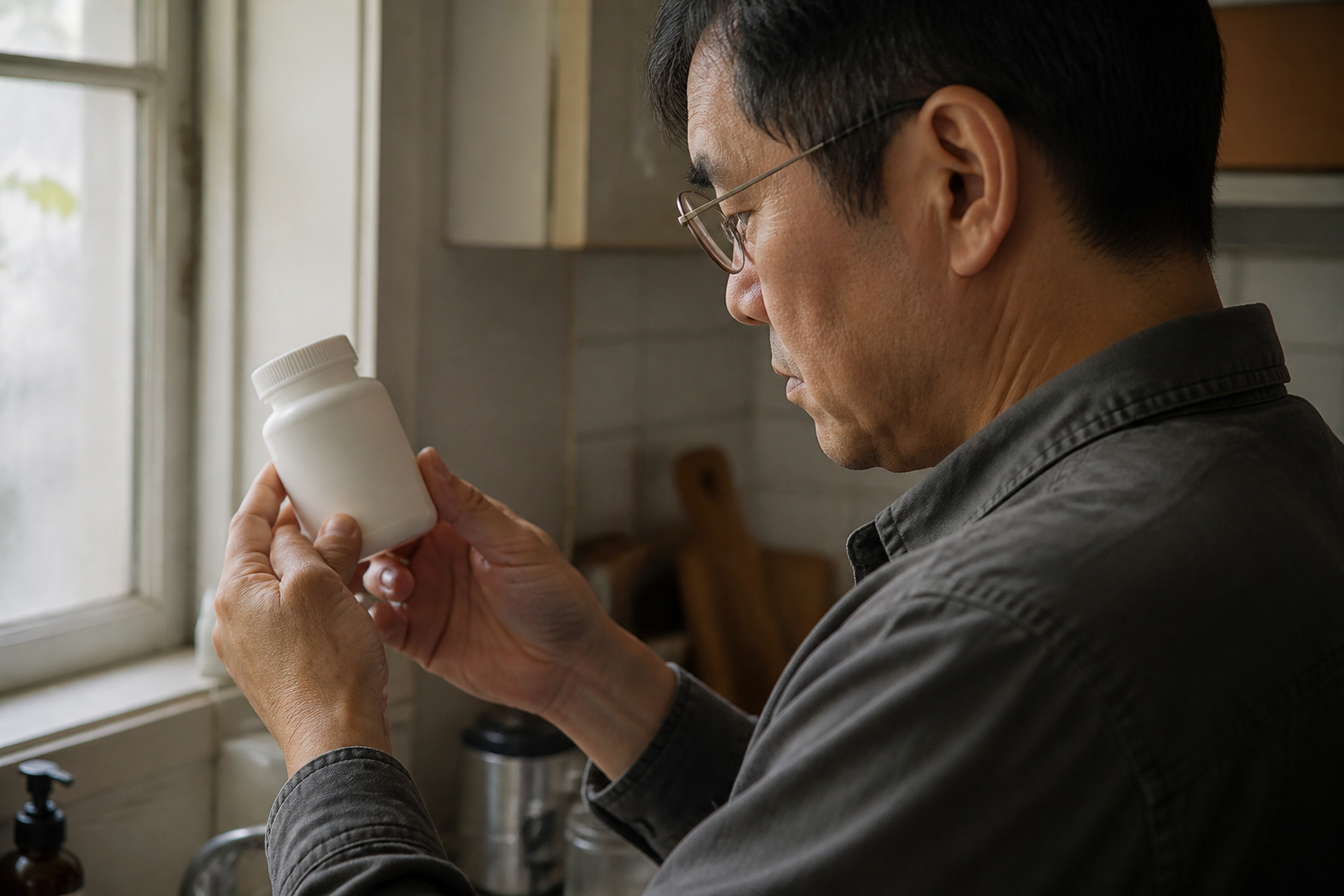
Nine label entries tell you a brain supplement was not built around evidence: vinpocetine, the racetams, noopept, phenibut, picamilon, huperzine A, DMAE, apoaequorin, and vitamin B6 above roughly 50 mg. Four of those — vinpocetine, racetams, noopept and phenibut — are not lawful US dietary ingredients according to FDA, and a 2020 analysis in Neurology: Clinical Practice detected five of them in US-sold cognitive supplements, often undeclared or mis-dosed. A tenth signal is not an ingredient at all: the words “proprietary blend”, which legally conceal every dose on the label.
The claim
Brain-supplement labels are written to be read as evidence. A long ingredient list implies thoroughness; an unfamiliar chemical name implies sophistication; a milligram figure implies precision. The claim under examination is that a longer, more exotic label means a better-formulated product.
The opposite is closer to true. Several of the most impressive-sounding entries in this category are the specific items that regulators have acted on, and the label convention that looks most professional — a named proprietary blend with a single total weight — is the one that makes the formulation impossible to evaluate. This page is the filter we apply before any product is discussed anywhere else on the site, and it sits alongside how we rate evidence.
Where it came from
The category inherited its vocabulary from three places: Soviet and Eastern-European pharmacology, which produced piracetam, phenibut, noopept and picamilon as prescription drugs; Chinese pharmacology, which produced huperzine A; and 1960s–1980s American supplement marketing, which produced DMAE. None of those origins is disqualifying by itself. What matters is that products designed and approved as drugs elsewhere are being sold in the US as dietary supplements, and the statutory definition of a dietary ingredient does not stretch that far.
The commercial reason is straightforward: an ingredient with genuine pharmacological activity produces a noticeable subjective effect, which produces repeat purchases and enthusiastic reviews. Bacopa, at a studied dose, produces a measurable change in attentional speed after twelve weeks and feels like nothing at all.
What the evidence actually shows
| # | Ingredient | Status | Why it is a red flag |
|---|---|---|---|
| 1 | Vinpocetine | Not a lawful dietary ingredient | FDA’s tentative conclusion, published in the Federal Register on 6 September 2016, is that it does not meet the statutory definition; a June 2019 FDA warning advised women of childbearing age to avoid it entirely12 |
| 2 | Racetams (piracetam, aniracetam, oxiracetam, pramiracetam, phenylpiracetam) | Not lawful dietary ingredients | FDA has issued warning letters on this basis, including to a nootropics seller in February 2019. Piracetam’s Cochrane review does not support use in dementia or cognitive impairment34 |
| 3 | Noopept (omberacetam) | Russian prescription drug | Not a vitamin, mineral, herb, amino acid or dietary substance. No independently replicated human RCT exists outside Russian-language sources5 |
| 4 | Phenibut | Not a lawful dietary ingredient | FDA states plainly that it does not meet the definition; dependence and a severe withdrawal syndrome are well documented. Warning letters were issued in April 2019 and a permanent injunction followed in June 20236 |
| 5 | Picamilon | Unapproved drug | One of the five unapproved drugs detected in US-sold cognitive-enhancement supplements, frequently undeclared5 |
| 6 | Huperzine A | Grey zone — discuss, do not recommend | A genuine reversible acetylcholinesterase inhibitor, the same class as donepezil, and an approved drug in China. Cochrane found the evidence inadequate to make any recommendation7 |
| 7 | DMAE | Near-zero cognitive evidence | Long-standing and still-unresolved developmental-toxicity concerns, with essentially no human cognitive trial base to weigh against them |
| 8 | Apoaequorin | Court-adjudicated claims | A protein taken orally and digested to amino acids. In December 2024 a federal court ordered the marketer to stop the deceptive memory and cognitive-improvement claims89 |
| 9 | Vitamin B6 above ~50 mg/day | Cumulative toxicity risk | Chronic high-dose B6 causes sensory peripheral neuropathy — numbness, tingling, gait ataxia — historically at 500 mg/day and upward but reported at doses as low as 50 mg/day with prolonged use. The tolerable upper intake level is 100 mg/day10 |
The four that are not lawful dietary ingredients
Vinpocetine is a semi-synthetic derivative of vincamine. FDA’s position is that it is a synthetic compound rather than a botanical constituent, and that it was authorized for investigation as a new drug before being marketed as a supplement — either alone is disqualifying under the statute. Products containing it are adulterated or misbranded.1
The racetams have the same problem. Piracetam is not approved as a drug in the US and does not meet the dietary-ingredient definition; FDA issued a warning letter to a nootropics seller on 5 February 2019 on exactly that basis.3 Phenylpiracetam is additionally on WADA’s prohibited list, which matters for anyone drug-tested in sport. Noopept is a Russian prescription drug. Phenibut is the one with a clinical consequence attached: dependence and a severe withdrawal syndrome are well documented, which makes it the most dangerous item routinely sold under the nootropics heading.6
⚠️ If you are already taking one of these
Do not stop phenibut abruptly. Withdrawal from it is a documented clinical syndrome, and stopping is a conversation to have with a doctor or pharmacist rather than a decision to make alone this evening. The same caution applies to anything you have been taking daily for months. For the other ingredients on this list, the reason to stop is that you are taking an unapproved drug at an unverified dose — tell your prescriber what you have been using, particularly if you take an anticoagulant, a cholinesterase inhibitor, or anything for a heart or seizure condition.
The grey-zone entry: huperzine A
Huperzine A is plant-derived, is not on FDA’s exclusion list, and is widely sold — so it is not illegal in the way the four above are. It is on this list for a different reason: it works pharmacologically like a drug, because it is one. Cochrane’s review of six trials in 454 Alzheimer’s patients found improvements on several scales but concluded that the methodological quality of most included trials was not high, only one study met adequate quality and size standards, and the evidence is inadequate to make any recommendation about its use.7
Two practical consequences. First, dementia trials used 0.2–0.4 mg/day while consumer supplements contain 0.05–0.2 mg — usually printed as 50–200 mcg, which looks trivially small and is not. Second, it must never be stacked with a prescribed cholinesterase inhibitor such as donepezil, rivastigmine or galantamine, because the toxicity is additive. It may also lower heart rate and worsen epilepsy, and it antagonizes anticholinergic drugs including antihistamines and tricyclic antidepressants.1112
The vitamin nobody checks
Vitamin B6 is the odd entry here because it is neither exotic nor illegal — it is in almost every B-complex, energy drink and “focus” formula on the shelf. The RDA is 1.3–1.7 mg/day. The tolerable upper intake level is 100 mg/day. Products routinely contain 25, 50 or 100 mg per serving, and a person taking a multivitamin plus a B-complex plus a nootropic blend can pass that ceiling without noticing.10
Chronic excess causes a sensory peripheral neuropathy: numbness and tingling in the hands and feet, and in more advanced cases gait ataxia. It is usually reversible on stopping, but not always. Australia’s Therapeutic Goods Administration has acted on this, and case numbers are not trivial. B6 alone has no demonstrated cognitive benefit in replete adults — Cochrane found insufficient evidence — so on a brain-supplement label a high B6 dose is risk without a corresponding upside. We cover this in detail in the vitamin B6 toxicity page.
The tenth flag is not an ingredient
“Proprietary blend” is a labelling convention that lets a manufacturer disclose only the combined weight of a group of ingredients. It is legal, it is common, and it makes evaluation impossible by construction. The arithmetic is the point: bacopa’s meta-analysed effect comes from 300–450 mg/day of an extract standardized to roughly 50–55% bacosides.14 A “focus blend” listing twelve botanicals at 500 mg total cannot contain a working dose of bacopa, or of anything else on that list.
The structural pattern around it is consistent enough to recognize on sight: an origin story about one unusual root, mushroom or nerve; a misattributed institutional source; the undisclosed blend; six-bottle bulk pricing with a 60-day refund guarantee; and “reviews” seeded across press-release newswires. A specific number of years of memory “reversed” is the version of this that regulators have already litigated over.13
Why the claim persists
Enforcement is slow and quiet. A warning letter is a document on fda.gov, not a recall. Products keep shipping while the paperwork moves, and a supplement bought through an overseas storefront may never encounter the process at all.
Real pharmacology feels like proof. An ingredient that is genuinely psychoactive produces a noticeable effect, and a noticeable effect is easily read as evidence of cognitive benefit. Phenibut is the clearest case: it does something, and what it does is not cognitive enhancement.
Labels are not verified before sale. The Cohen analysis matters precisely because it tested products rather than reading them: five unapproved drugs turned up in US-sold cognitive supplements, frequently at doses above pharmacological norms, and often undeclared or mis-declared.5 A clean label is weaker evidence than most buyers assume.
What to do instead
- Read the label backwards. Start at “other ingredients” and the blend line. If per-ingredient doses are not printed, you cannot compare the product to any trial, and neither can we.
- Check the B6 number against everything else you take. The ceiling is cumulative across products, not per bottle.
- Prefer single ingredients at studied doses. One compound at a dose that appears in a published trial is testable. A blend is not.
- Look for a manufacturer address and third-party testing. Their absence, next to six-bottle pricing, is the pattern above.
- Start from the evidence, not the shelf. The tier list shows which compounds have human trials behind them and in whom; the ingredient pages give the doses those trials used.
What would change our mind
For the four unlawful ingredients, the thing that would change this page is regulatory: an FDA determination that one of them does meet the statutory definition of a dietary ingredient, or a new-dietary-ingredient notification accepted for it. For huperzine A, it would be a large, high-quality, independently conducted trial with long-term safety follow-up beyond the 36 weeks currently available. For DMAE, it would be the first adequately powered human cognitive trial — there is not one to argue with yet.
Frequently asked questions
If these ingredients are illegal, why can I buy them?
US supplements are not approved before sale. FDA acts after a product is on the market, usually through warning letters, and that process is slow. Products containing these ingredients are treated as adulterated or misbranded, but they remain purchasable in the meantime, particularly from overseas sellers.
Is huperzine A dangerous?
The short trials reported no serious adverse events, but the longest ran 36 weeks, so long-term safety is unknown. The specific risks worth knowing are additive toxicity with prescribed cholinesterase inhibitors, a possible drop in heart rate, worsening of epilepsy, and reduced effectiveness of anticholinergic medicines.
How much vitamin B6 is too much?
The tolerable upper intake level is 100 mg/day, and neuropathy has been reported at doses as low as 50 mg/day with prolonged use. The RDA is 1.3–1.7 mg/day, so a 50 mg tablet is roughly thirty times a day’s requirement. Add up every product you take rather than checking one label.
Does a proprietary blend always mean a bad product?
It means an unevaluable one. There is no way to tell whether a blend contains a studied dose of anything, which is why we do not compare blends to trial evidence. A manufacturer confident in its doses has no reason to hide them.
Related reading
- Do nootropics actually work? — every compound, tier and population
- The case against brain supplements — the trials that failed
- How we rate evidence — what we accept as a source
- Nootropics — doses from the actual studies
- Editorial policy — why no product is linked on this page
Sources
- FDA: Vinpocetine in dietary supplements
- Federal Register: Request for comment on the status of vinpocetine (2016)
- FDA warning letter: Peak Nootropics LLC / Advanced Nootropics, 5 February 2019
- Analysis of piracetam in dietary supplements sold in the US
- Cohen et al., unapproved drugs in cognitive-enhancement supplements, Neurology: Clinical Practice 2020
- FDA: Phenibut in dietary supplements
- Cochrane: insufficient evidence on the effects of huperzine A in Alzheimer’s disease
- FTC statement on its win in the lawsuit against the makers of Prevagen (December 2024)
- FTC case file: Quincy Bioscience Holding Company
- NIH Office of Dietary Supplements: Vitamin B6
- Cognitive Vitality: Huperzine A rating (Alzheimer’s Drug Discovery Foundation)
- NCBI Bookshelf: Huperzine A monograph
- FTC business guidance: the Prevagen complaint and memory claims (2017)
- Kongkeaw et al., meta-analysis of Bacopa monnieri randomized controlled trials, J Ethnopharmacol 2014
These statements have not been evaluated by the Food and Drug Administration. Nothing here is intended to diagnose, treat, cure or prevent any disease.
This article is information, not medical advice. Talk to a doctor or pharmacist about your own situation, especially if you take prescription medication.