
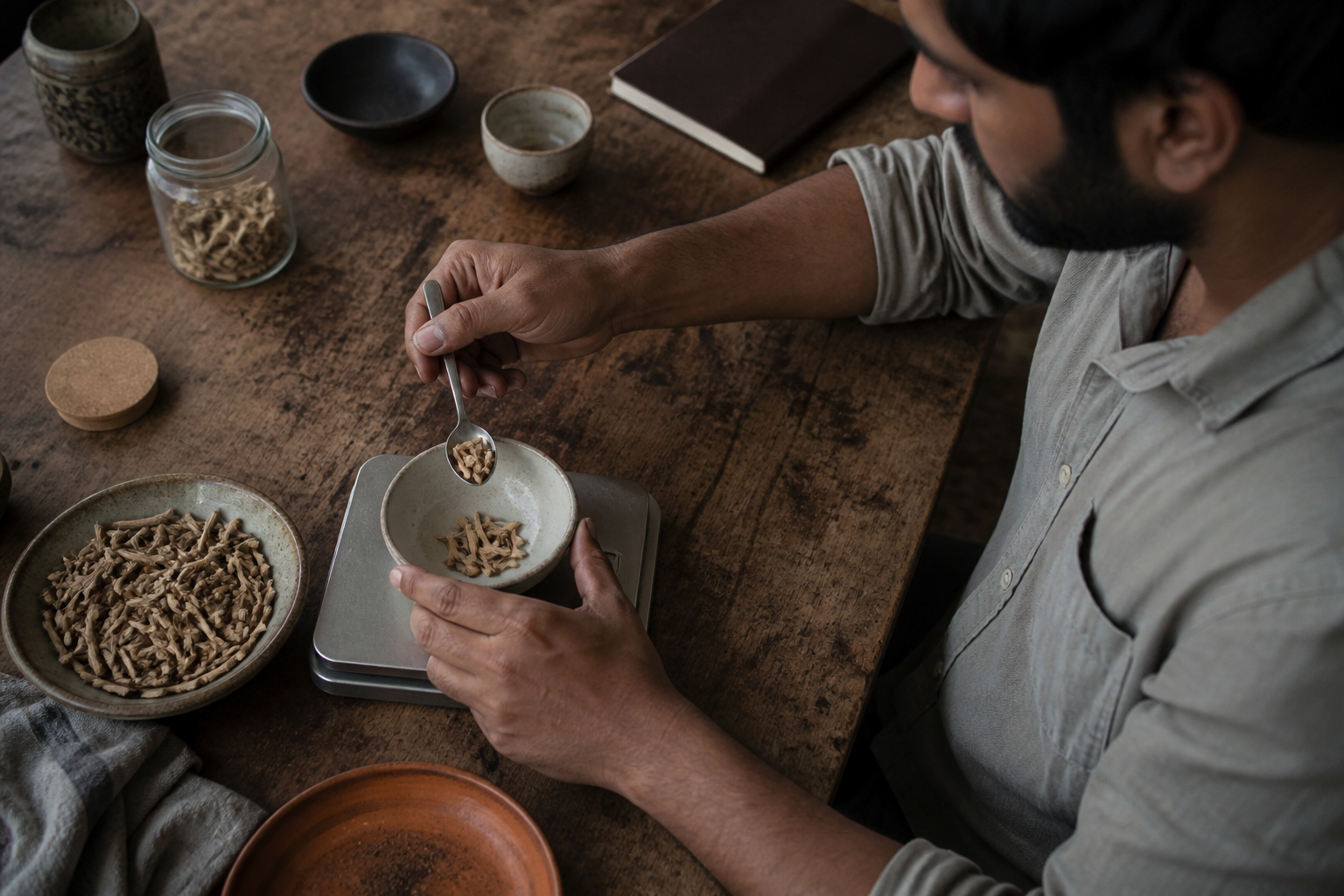
Ashwagandha trials used 225–675 mg/day of root extract, most commonly 600 mg/day taken as 300 mg twice daily, for durations running from 7 days to 16 weeks — mostly 8. The 2026 meta-analysis behind the current numbers pooled 20 RCTs and 1,249 participants and reported memory SMD 0.52 and attention/processing speed SMD 0.29, in generally healthy adults aged 18 to 75, 14 of those 20 trials conducted in India and many with manufacturer involvement. There is no established safety ceiling to point at: the published liver-injury cases span 154 to 2,100 mg/day, which means the low end of the case series sits below the common consumer dose.
We’re not recommending a product on this page. None of the three supplements we have vetted contains ashwagandha, and we are not going to invent a fit for a compound that carries a LiverTox likelihood score of B. Start with the tier list — it shows which compounds have human trials behind them and which don’t.
See the tier list →The doses that appear in trials
| Trial or analysis | Population | Daily dose | Duration | Outcome |
|---|---|---|---|---|
| 2026 systematic review and meta-analysis, Frontiers in Pharmacology | 20 RCTs, 1,249 participants, trials published 2011–2025; generally healthy adults 18–75; 14 of 20 trials in India | 225–675 mg root extract, most commonly 600 mg (300 mg twice daily) | 7 days to 16 weeks, mostly 8 weeks | Memory SMD 0.52; attention/processing speed SMD 0.29; executive function SMD −0.42; visuospatial SMD 0.39 after sensitivity analysis. Also testosterone SMD 0.33 and muscle strength SMD 0.58 |
| KSM-66 branded extract trials | Adults, as above | Typically 300–600 mg | Varies | The higher-dose, lower-withanolide-concentration convention |
| Sensoril branded extract trials | Adults, as above | 125–250 mg | Varies | Higher withanolide content, lower total dose — not interchangeable milligram for milligram with KSM-66 |
| NIH LiverTox case series (2024 update) | ~23 published cases of clinically apparent liver injury | 154–2,100 mg across cases | Latency typically 2–12 weeks | Likelihood score B — a likely cause. Predominantly cholestatic or mixed, with jaundice and itching. Most resolved in 1–4 months after stopping; rare fatal injury or emergency transplant |
| Global cognition | — | — | — | Assessed in only one of the 20 trials. The domain scores above are not a general cognition result |
The dose most people should have in mind is 600 mg/day of a root extract, split into two 300 mg doses, for eight weeks. That is not a recommendation — it is a description of what the trials did.1
What that means for a healthy adult
Efficacy tier: Moderate. Safety: Avoid if you take thyroid medication, have liver disease, have an autoimmune condition, or are pregnant.
The numbers in that table are respectable and they need their caveats read alongside them. Fourteen of twenty trials were run in India, many by or with manufacturer involvement; publication bias in this literature is a real concern; only one study assessed global cognition; and durations were mostly eight weeks, so nothing here speaks to a year of use.1
There is also a mechanism question that changes how you should read the dose. Ashwagandha’s most robust and consistent effect is on subjective stress, anxiety and cortisol — and part of the cognitive signal is plausibly downstream of reduced stress and better sleep rather than a direct action on memory. If that is what is happening, then the dose that matters is the one that changes how you sleep and how stressed you feel, and the cognitive numbers are a second-order consequence.
Why the dose on your bottle is probably different
- Extract standardisation is the whole ball game. Sensoril trials use 125–250 mg because the material is higher in withanolides; KSM-66 trials use 300–600 mg. “500 mg of ashwagandha” without a withanolide percentage and an extract name tells you almost nothing about what you are taking.1
- Root extract is what was studied. The trial doses above are root extract. A product that does not say which part of the plant it used is not describing the same intervention.
- Per serving, not per capsule. “600 mg” over a serving size of two capsules is 300 mg per capsule. This is the single most common way people end up at half the studied dose.
- Proprietary blends hide it entirely. Ashwagandha inside a “stress complex 900 mg” could be 400 mg or 40 mg. Ingredients are listed by descending weight and nothing else is disclosed, so the number cannot be recovered from the label.
- Whole-herb powder is not extract. Powdered root and a standardised extract are different materials at different potencies, and the trial doses do not transfer.
Safety ceiling and who should not take this
This is the section that matters more than the dose table, because ashwagandha’s problem is not that people take too much. The published liver-injury cases ran from 154 to 2,100 mg/day — the bottom of that range is below the standard 600 mg trial dose. There is no dose that has been shown to be safe from this particular risk, and pretending otherwise by quoting a ceiling would be inventing one.23
⚠️ Stop and see a doctor
Jaundice (yellowing of skin or eyes), dark urine, pale stool, pain in the upper right abdomen, unexplained fatigue, or itching. Latency for supplement-associated liver injury is typically 2 to 12 weeks after starting, so a symptom that appears a month in is not too late to be connected. Most reported cases resolved within 1 to 4 months of stopping, but there are rare instances of fatal liver injury and of emergency transplant, particularly in people with pre-existing cirrhosis. Denmark and Iceland have restricted or advised against ashwagandha products.24
⚠️ Talk to your prescriber first
Thyroid medication: ashwagandha raises T3 and T4 in some studies, can precipitate thyrotoxicosis, and may make levothyroxine dosing unstable — avoid it or clear it first. Sedatives, benzodiazepines, alcohol: additive CNS depression. Immunosuppressants and autoimmune disease: it has immunostimulant activity — avoid in autoimmune conditions and in transplant patients. Blood pressure and diabetes medication: may lower both additively. Pregnancy: contraindicated. Nightshade-family allergy is also possible.
Ashwagandha is not the only thing in a typical supplement drawer that interferes with thyroid medication, which is the most under-flagged interaction category in this field. Acetyl-L-carnitine is a peripheral antagonist of thyroid hormone action and can reduce levothyroxine’s effectiveness;5 L-tyrosine is a thyroid hormone precursor and is contraindicated in hyperthyroidism;6 bacopa has shown T4 elevation in rodents, which is preclinical but worth a mention to a clinician.7
What we don’t know
Whether the effect is dose-dependent at all. The trials cluster at 300 and 600 mg with almost nothing in between and nothing above 675 mg, so the shape of the curve is unmapped. Whether anything persists past sixteen weeks is unknown, as is whether the effect survives outside the trial base that produced it — the geographic and sponsorship concentration is the single biggest open question about that memory SMD of 0.52. And nobody has established what separates the roughly 23 people with a published liver injury from the many thousands who take it without incident.
What would change our mind
A large, independently funded, non-Indian RCT of 600 mg/day of a named standardised root extract against placebo for at least six months, with global cognition as a primary outcome and liver enzymes measured serially. If it reproduced the memory effect and showed no enzyme signal, both halves of this page would change. For comparison, that is roughly the standard the multivitamin arm of COSMOS met — three years, thousands of participants, replicated across sub-studies8 — and no botanical in this field has met it yet.
Frequently asked questions
Is 300 mg or 600 mg the right dose?
600 mg/day, split into two 300 mg doses, is the most common trial dose for root extract. But if you are taking a Sensoril-type extract, its own trials used 125–250 mg because the withanolide concentration is higher. Match the dose to the extract, not to a number you read somewhere.1
How long until it does something?
Most trials ran eight weeks, with a range from 7 days to 16 weeks. Eight weeks is the interval to judge it on. It is also the middle of the 2-to-12-week window in which liver injury has typically appeared, which is an argument for deciding at eight weeks rather than drifting into indefinite use.12
Should I cycle it?
No trial has tested cycling, so any specific on-off schedule you read is invented. What the evidence does support is a defined trial period with an end date, rather than an open-ended habit.
Is there a cheaper compound with better evidence?
For adults over 65, the plain daily multivitamin in COSMOS has more evidence than any botanical here.8 Creatine monohydrate at 3–5 g/day has a memory effect of SMD 0.29, concentrated in adults aged 66–76 and near zero in the young.9 Neither carries a liver signal.
Related reading
- Ashwagandha and Levothyroxine: Read This First
- Nootropics and Antidepressants: A Compound-by-Compound Interaction Guide
- Do Nootropics Actually Work? An Honest Tier List
- Supplements That Cause Brain Fog
- Nine Ingredients That Signal a Bad Brain Supplement
- How we rate evidence
Sources
- Systematic review and meta-analysis of ashwagandha: 20 RCTs, 1,249 participants (Frontiers in Pharmacology, 2026)
- NIH LiverTox: Ashwagandha (likelihood score B), 2024 update
- Critical review of the adverse effects of Withania somnifera (Phytotherapy Research)
- Ashwagandha safety review (PubMed Central, PMC11800443)
- Acetyl-L-carnitine: a 2020 critical update (Nutrients)
- Jongkees et al., tyrosine and cognitive control under demanding conditions (J Psychiatr Res, 2015)
- Kongkeaw et al., meta-analysis of standardized bacopa extracts (J Ethnopharmacol, 2014)
- COSMOS-Mind: multivitamin supplementation and cognition in older adults (Alzheimer’s & Dementia, 2022)
- Prokopidis et al., creatine supplementation and memory: meta-analysis of 8 RCTs (Nutrition Reviews, 2023)
These statements have not been evaluated by the Food and Drug Administration. Nothing here is intended to diagnose, treat, cure or prevent any disease.
This article is information, not medical advice. Talk to a doctor or pharmacist about your own situation, especially if you take prescription medication.