
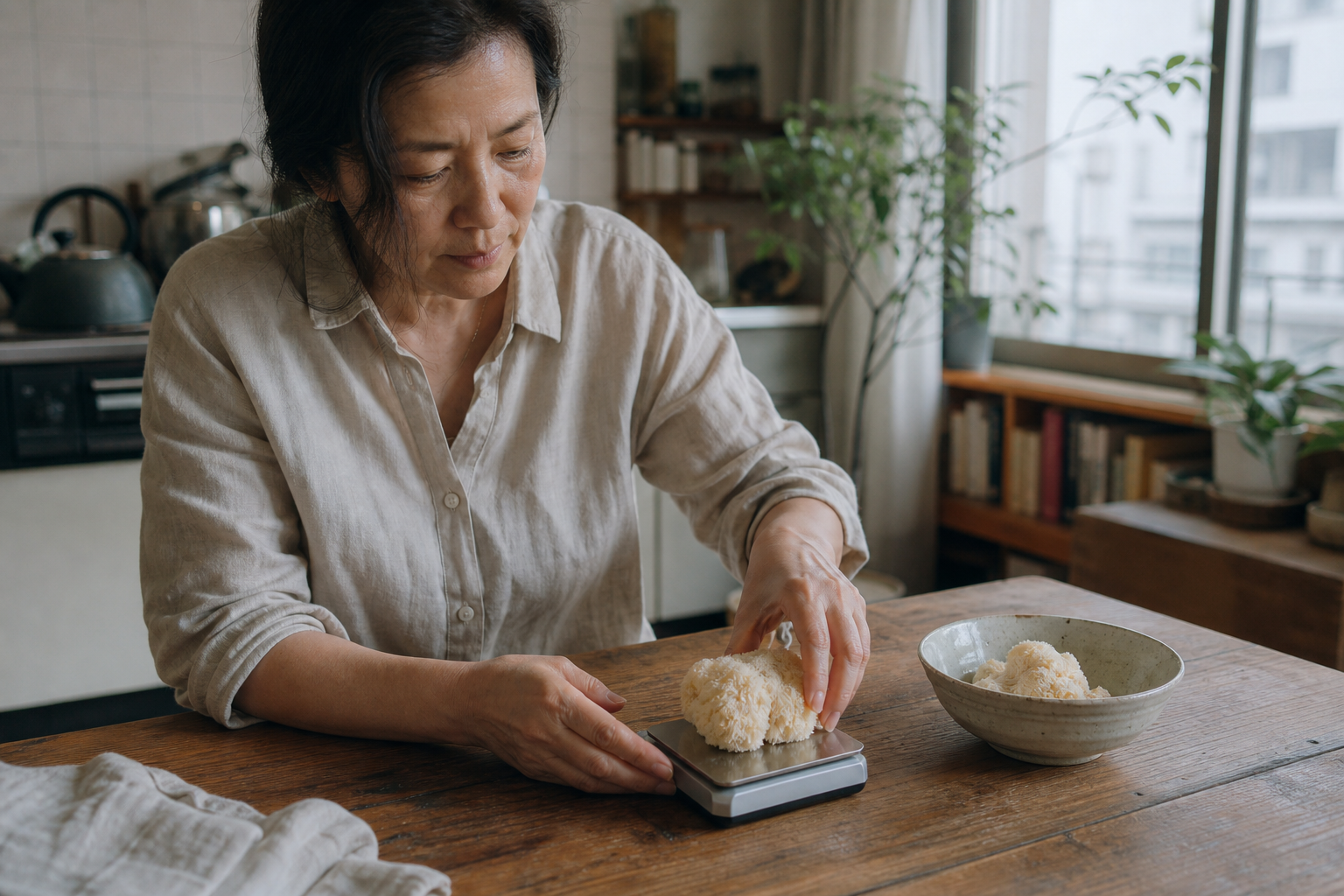
The most-cited lion’s mane trial (Mori 2009) gave Japanese adults aged 50–80 with mild cognitive impairment three 250 mg tablets of 96% Hericium erinaceus dry powder, three times a day — about 2,250 mg daily — for 16 weeks. Across the seven small human trials that exist, doses run up to roughly 3 g/day of fruiting-body material for 4 to 49 weeks. No dose has been established for any indication, and the trials that used the highest doses are not the trials that found the clearest effects.
NeuroPrime is a sublingual drop containing nine botanicals, lion’s mane among them, alongside moringa, pine bark, ginkgo, tamarind, chlorella, bacopa, spirulina and neem. It discloses no per-ingredient doses at all, so we cannot tell you whether its lion’s mane content is anywhere near the 2,250 mg used in Mori 2009 — and nine botanicals in one drop constrains total deliverable mass severely. We can describe it; we cannot recommend it on its formulation, because that formulation is unknowable.
We earn a commission if you buy through this link. It costs you nothing extra and it does not change what we write.
Full NeuroPrime review: ingredients, price, evidence →
Check the current price →The doses that appear in trials
Lion’s mane has seven small, short randomized controlled trials behind it, and their results do not agree.23 Here is what each one gave, to whom, and what came out.
| Trial | Population | Daily dose | Duration | Outcome |
|---|---|---|---|---|
| Mori 2009 (n=30) | Japanese adults 50–80, MCI | ~2,250 mg powder | 16 weeks | Scores rose, then fell back after stopping |
| Healthy older adults (n=31) | Adults 50+ | Not reported | 12 weeks | Better on 1 of 3 tests; placebo improved too |
| Healthy young adults (n=41) | Adults 18–45 | Not reported | 4 weeks | Fewer words recalled than placebo |
| Two further trials | Healthy young adults | Not reported | Short | No cognitive improvement |
| Dementia trial | Diagnosed dementia | Not reported | 49 weeks | Daily-living scores rose; cognition did not |
Read the third column again. Only one of these trials reports a dose we can quote with any confidence, and that is the reason every lion’s mane label you will ever pick up is guessing. The published range for fruiting-body material tops out around 3 g/day, which is where most supplement labels have landed — but landing inside a range is not the same as matching a trial.2
The Mori result is also the one people quote without its ending. Cognitive scores in the treated group improved over the 16 weeks of dosing and then declined again in the follow-up period after the supplement stopped.1 Whatever that trial measured, it did not persist.
What that means for a healthy adult
Most of these trials were not run in healthy adults, and the ones that were came back null or negative. Our tier for lion’s mane is Weak — mostly preclinical work, small studies, inconsistent human data.
The specific finding worth sitting with: in 41 healthy adults aged 18–45 taking it for four weeks, the lion’s mane group recalled fewer words on a delayed recall task than placebo.2 That is one small trial and it should not be over-read, but it is the opposite of the marketing, and a site that only reports the Mori number is not telling you what the literature says.
For context on what a genuinely positive cognitive trial looks like at this scale: the COSMOS programme randomized thousands of older adults for three years and found a measurable benefit — from a plain daily multivitamin-mineral, not from any mushroom.456 Seven trials of under 50 people each is a different evidentiary universe. We keep the whole field ordered by that standard in our honest tier list.
Why the dose on your bottle is probably different
Four things stand between a trial number and a capsule.
- Per-capsule versus per-serving. A label reading “1,000 mg” often means per serving, and the serving is two or three capsules. Mori’s regimen was three tablets taken three times a day — nine tablets daily. Almost nobody dosed like that at home.
- Powder versus extract. Mori used 96% dry powder. An “8:1 extract” at 500 mg is a different material entirely, and the ratio tells you about the manufacturing process, not about the concentration of anything you care about.
- Proprietary blends. If lion’s mane sits inside a blend with a single combined weight, its individual dose is undisclosed by design. That is one of the signals we treat as disqualifying.
- Standardization that isn’t. “Standardized to 30% polysaccharides” is not a lion’s mane specification — starch is a polysaccharide. Beta-glucan content is the more meaningful number and far fewer products publish it.
Where a marketing claim outruns its evidence, US regulators have shown they will act on it. The FTC and the New York Attorney General sued the maker of Prevagen over memory claims in 2017, and in December 2024 a federal court ordered the company to stop making them.78 That case is the reason we phrase everything on this page the way we do.
Form matters more than milligrams here
Lion’s mane products come from two different parts of the organism, and they are not interchangeable.
Fruiting body — the visible mushroom — is where hericenones are claimed to sit. This is the material used in the human trials, including Mori’s. Mycelium, usually grown on grain, is the source of erinacine A, and erinacine-enriched products are dosed differently, generally lower.2 Quoting a fruiting-body trial dose on a mycelium product, or the reverse, is a category error — and mycelium-on-grain products also carry the residual grain into the capsule, which inflates the weight on the label without adding mushroom.
Both hericenones and erinacines earned their reputation the same way: by stimulating nerve growth factor in cell culture and in rodents. NGF is a large protein that does not cross the blood–brain barrier, and no one has shown that an oral mushroom extract raises NGF in a human brain.23 That is a mechanism, not an effect, and the distinction is the whole ballgame — a point we make at length in the case against brain supplements.
Safety ceiling and who should not take this
There is no established upper limit, because there is no established dose. Trials at up to 3 g/day report good tolerability, with GI discomfort, nausea and skin rash the common complaints.2 One case report describes severe respiratory failure possibly related to consumption, consistent with mushroom hypersensitivity pneumonitis.2
⚠️ Talk to your prescriber first
Lion’s mane has theoretical antiplatelet activity, so anyone on warfarin, apixaban, rivaroxaban, clopidogrel or aspirin should clear it with their prescriber rather than assume it is inert. It may also lower blood glucose — if you take insulin or a sulfonylurea, monitor. Anyone with a mushroom allergy should avoid it outright. And botanicals generally should stop at least two weeks before surgery; see what to stop before an operation.
Community reports — not trial data
Forum users commonly describe an itchy or “tingly” scalp in the first weeks and read it as nerve growth. Others report vivid dreams, and a minority report a flat, demotivated feeling that resolves on stopping. None of this has been measured in a trial, in either direction. It is worth knowing that people say it; it is not evidence that it happens.
What we don’t know
We do not know a minimum effective dose, whether fruiting body and mycelium are even comparable at equal weight, whether any effect persists past the dosing period (Mori’s did not), or whether the one negative finding in healthy young adults is signal or noise. We also have no long-term safety data at gram doses beyond 49 weeks. The Alzheimer’s Association’s summary of alternative treatments places lion’s mane in the same category as most of this field: interesting, unproven.9
What would change our mind
A pre-registered, adequately powered RCT — several hundred participants, at least six months, a defined and disclosed extract with published beta-glucan and hericenone content, dosed against placebo in a clearly specified population, with a follow-up window after dosing stops. If that trial found a durable effect on a primary cognitive endpoint, we would raise the tier the same week. Seven trials averaging 35 people cannot settle this, and no amount of adding them together will.
Frequently asked questions
How much lion’s mane per day did the studies actually use?
Mori 2009 used about 2,250 mg/day of 96% dry powder in nine divided tablets, in adults 50–80 with mild cognitive impairment, for 16 weeks. The published range across trials reaches roughly 3 g/day. Most other trials did not report a dose we can verify.
How long before lion’s mane does anything?
The trials that reported any cognitive change ran 12 to 16 weeks. The four-week trial in healthy young adults found a negative result on delayed recall. Nothing in the human record supports an acute or same-day effect.
Is fruiting body or mycelium the better dose?
Neither has been shown better in a head-to-head human trial. Fruiting body is what the human trials used, so if you want to match a study, that is the material to match. Erinacine-enriched mycelium is a different product at different doses and its trial base is thinner still.
Can you take lion’s mane with an antidepressant?
There is no documented pharmacokinetic interaction between lion’s mane and SSRIs or SNRIs, but “no documented interaction” mostly reflects how little has been studied. Our compound-by-compound guide covers what is and isn’t known there.
Does a bigger dose work better?
No dose-response relationship has been demonstrated in humans. The trial with the clearest positive result was not the trial with the highest dose, and going above 3 g/day takes you outside the range anyone has tested.
Related reading
- Do Nootropics Actually Work? An Honest Tier List
- Ginkgo Biloba: Two Enormous Trials, Two Failures
- L-theanine Dosage: What Was Actually Used in the Studies
- Nine Ingredients That Signal a Bad Brain Supplement
- Cognitive Supplements to Stop Before Surgery
- How We Rate Evidence
Sources
- Mori K, et al. Improving effects of Hericium erinaceus on mild cognitive impairment: a double-blind placebo-controlled clinical trial (2009)
- Cognitive Vitality (Alzheimer’s Drug Discovery Foundation) — Lion’s Mane rating
- Frontiers in Nutrition (2025) — Hericium erinaceus and cognition, systematic review
- COSMOS-Mind: multivitamin and cocoa extract effects on cognition, Alzheimer’s & Dementia
- COSMOS-Clinic and meta-analysis of the three COSMOS cognitive studies, Am J Clin Nutr
- COSMOS trial — published results
- FTC statement on its win against the makers of Prevagen (December 2024)
- FTC case file: Quincy Bioscience Holding Company
- Alzheimer’s Association — alternative treatments
These statements have not been evaluated by the Food and Drug Administration. Nothing here is intended to diagnose, treat, cure or prevent any disease.
This article is information, not medical advice. Talk to a doctor or pharmacist about your own situation, especially if you take prescription medication.