
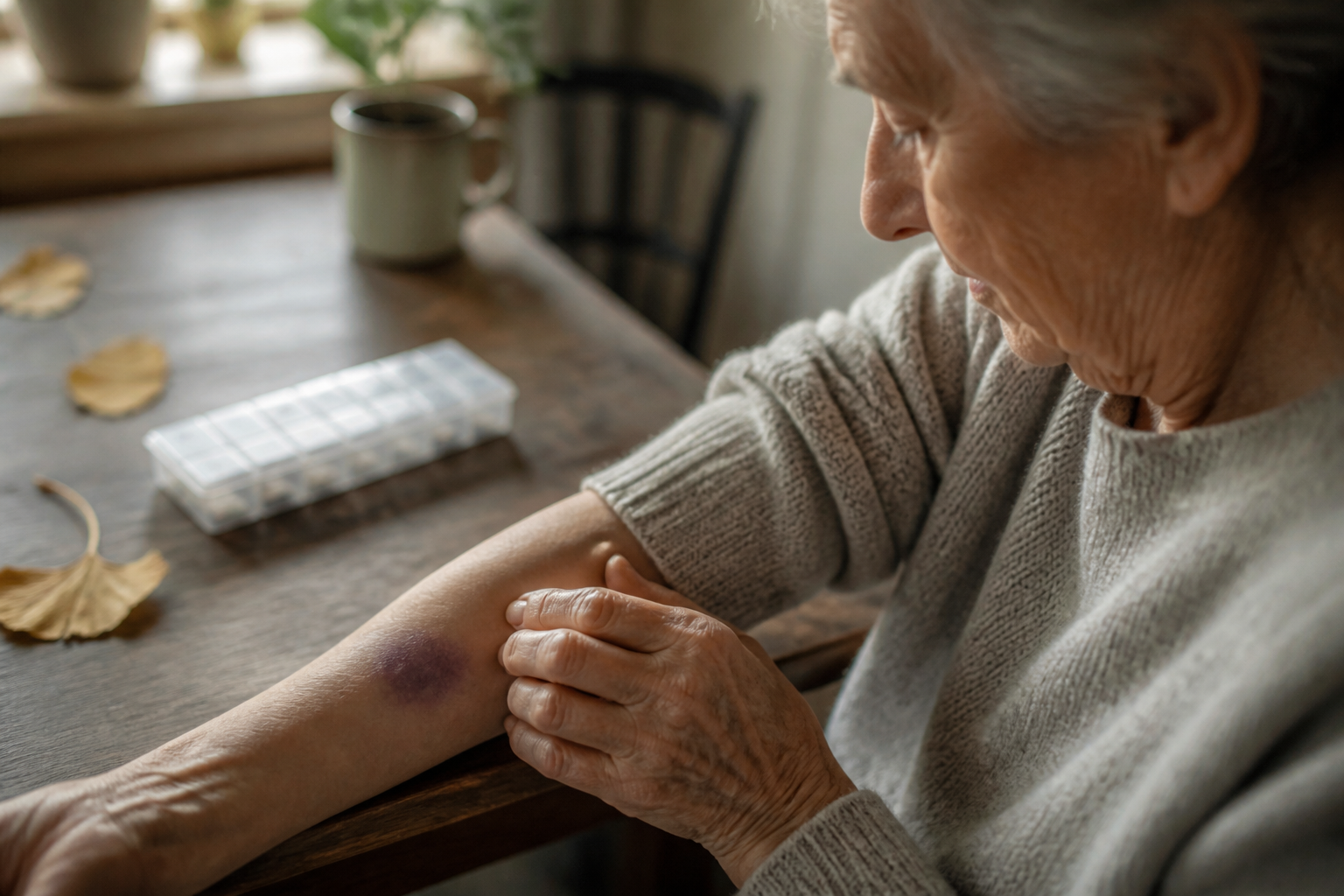
Ginkgo’s ginkgolides antagonize platelet-activating factor, so the mechanism for additive bleeding risk on top of a blood thinner is real and well characterized. What has actually been observed in people is a small number of published case reports of serious bleeding — set against controlled pharmacokinetic work that has been more reassuring, and a 2026 Cochrane review finding probably little or no difference in overall or serious adverse events versus placebo over up to 12 months. Those are different classes of evidence, and this page keeps them apart. Our position is still to warn, and the reason is not the size of the risk: it is that the expected benefit is close to zero, which makes even a small risk a bad trade. If you take warfarin, apixaban, rivaroxaban, clopidogrel or daily aspirin, this is a conversation with whoever prescribed it before it is a purchase.
The mechanism
Platelet-activating factor is a signalling lipid that makes platelets aggregate. Ginkgolides — the terpene lactones in standardized ginkgo extract — antagonize it1. That is documented pharmacology rather than an inference from a symptom, and it is why ginkgo sits at the top of every herb-anticoagulant caution list.
It matters that “blood thinner” covers two different drug classes acting at two different points. Antiplatelet drugs — aspirin, clopidogrel — stop platelets clumping. Anticoagulants — warfarin, and the direct oral anticoagulants apixaban and rivaroxaban — interfere with the clotting cascade. Ginkgo’s mechanism is antiplatelet, so the theoretical concern is most direct with aspirin, clopidogrel and NSAIDs, which also inhibit platelet function; with warfarin and the DOACs you are stacking two different mechanisms rather than doubling one.
Ginkgo may also inhibit CYP2C193. Warfarin is metabolized in part by that pathway, which is a second and separate route to a level change. That is a mechanism argument, not a measured effect on INR.
What has actually been documented
This section is split three ways deliberately, and the heading a claim sits under is the point.
Documented
The pharmacology. Ginkgolide antagonism of platelet-activating factor is established — a real effect on a real pathway4.
The trial safety data, which point the other way. The 2026 Cochrane review — 82 studies, 10,613 participants, searched to November 2024 — found probably little or no difference in overall adverse events or serious adverse events versus placebo up to 12 months1. Controlled pharmacokinetic studies of ginkgo with anticoagulants have likewise been more reassuring than the case literature4. An honest page has to put that in the same section as the mechanism, because it is the strongest evidence here and it does not support alarm.
The efficacy data, which is what makes this a bad trade. Cochrane concluded ginkgo probably makes little or no difference in mild cognitive impairment at six months, with possible modest short-term benefit only in established dementia, and results varying considerably1. The two large prevention trials failed outright: GEM, about 3,069 participants on 240 mg/day of EGb 761 for a median 6.1 years, did not reduce incidence of all-cause dementia or Alzheimer’s, and GuidAge, about 2,854 participants over five years, did not reduce progression to Alzheimer’s in older adults with memory complaints2. For a healthy adult on a blood thinner, the expected cognitive gain is not small — it is absent. No effect See ginkgo biloba: two enormous trials, two failures.
Case reports
Published case reports describe subdural hematoma, hyphema (bleeding into the front chamber of the eye) and intracerebral bleeding in ginkgo users4. These are observed events in named individuals. They are not a rate, they do not establish that ginkgo caused the bleed, and the denominator is unknown against a product used by millions. They are enough to justify caution and nowhere near enough to quantify risk. Treating them as an incidence figure would be exactly the error this page exists to avoid.
Theoretical concerns
Additive bleeding risk when ginkgo is combined with warfarin, apixaban, rivaroxaban, clopidogrel, aspirin or NSAIDs is a mechanism argument. It follows from platelet-activating factor antagonism plus the drug’s own action, and it has not been demonstrated as an increased bleeding rate in a controlled trial of the combination. The same theoretical status applies to the perioperative advice to stop botanicals at least two weeks before surgery: prudence, not a trial result.
| Drug or class | Direction of effect | Evidence status | Practical implication |
|---|---|---|---|
| Aspirin, clopidogrel, NSAIDs | Additive antiplatelet effect | Theoretical — same mechanism | Highest mechanistic overlap; clear it with your prescriber |
| Warfarin | Additive bleeding, plus possible CYP2C19 route | Theoretical; controlled studies reassuring | Do not start without your anticoagulation clinic knowing |
| Apixaban, rivaroxaban | Additive bleeding | Theoretical | Same conversation — and no INR to monitor |
| Any anticoagulant, before surgery | Additive bleeding | Prudential | Stop botanicals at least two weeks before |
| Ginkgo alone, in trials | Adverse events | Documented — 82 studies, 10,613 participants | Probably little or no difference vs placebo to 12 months |
| Serious bleeds in users | Subdural hematoma, hyphema, intracerebral | Case reports | Real events; no rate, no proven causation |
How serious this is
Both the alarmist and the dismissive versions of this page are wrong, so calibration matters more here than anywhere else on this site.
The dismissive version says the trials found no excess adverse events, so the warnings are folklore. That misreads what those trials measured. Cochrane’s safety finding is about ginkgo compared with placebo, in trial populations, over up to twelve months. It is not a study of ginkgo added to warfarin in people already at elevated bleeding risk — and people on anticoagulants are routinely excluded from trials of this kind. Absence of a signal in a population that excluded the people at risk is weak evidence about those people. The alarmist version treats a handful of case reports as an incidence rate and tells readers ginkgo causes brain bleeds. It does not establish that.
The position that survives both is an asymmetry argument rather than a risk estimate. On the benefit side: two enormous prevention trials found nothing, and Cochrane finds little or no difference in mild cognitive impairment. On the risk side: a real mechanism, a handful of serious case reports, and reassuring but non-specific controlled data. When the expected benefit is near zero, the risk does not need to be large or well quantified for the trade to be bad. That is the whole argument, and it does not depend on exaggerating the danger.
Two other ginkgo safety points belong here. Ginkgotoxin (4′-O-methylpyridoxine) is a vitamin B6 antagonist concentrated in ginkgo seeds; raw seed consumption has caused seizures, and ginkgo should be avoided by people with epilepsy or taking drugs that lower the seizure threshold318. And product quality is a documented problem in this category: non-standardized ginkgo products are not comparable to the EGb 761 extract used in nearly all the research, and adulteration is documented3.
What to do instead
⚠️ Talk to whoever prescribed the anticoagulant
This is the real advice on this page, not boilerplate. Anticoagulation is dose-titrated against your individual bleeding risk, and the person managing that needs to know about anything with antiplatelet activity. A pharmacist can check it in minutes without an appointment. If you are on warfarin, adding or stopping anything with vitamin K content or platelet activity is a reason to check INR sooner rather than at the next scheduled appointment. Do not change an anticoagulant dose yourself on the strength of anything you read here.
- Do not start ginkgo to prevent cognitive decline. That is the use with the clearest negative evidence, from the two largest trials ever run on it.
- Stop botanicals at least two weeks before any surgery or dental extraction, and tell the surgical team what you have been taking.
- Know the rest of the additive-bleeding list, because ginkgo is rarely alone in a stack. High-dose omega-35, curcumin8, resveratrol9, saffron10, vitamin E and piracetam16 all carry additive bleeding cautions; phosphatidylserine11 and lion’s mane12 are listed as theoretical. On omega-3 specifically, the NIH Office of Dietary Supplements notes that most research shows 3–6 g/day of fish oil does not significantly affect warfarin’s anticoagulant action, though INR should be monitored periodically5 — and there is a published case report of a fatal outcome combining omega-3 with warfarin in traumatic brain injury6.
- Know the opposite direction too, because it is less obvious and equally important. Panax ginseng13 and CoQ1014 can reduce anticoagulant effect and lower INR — CoQ10 because its structure resembles vitamin K2 — and there are case reports of acetyl-L-carnitine increasing INR15. A supplement that makes your anticoagulant work less well is not safer than one that makes it work more.
- If you also take an antidepressant, the picture changes again — see nootropics and antidepressants, which covers the pharmacokinetic pathways in more detail.
Signs that would mean stopping
- Seek emergency care for a sudden severe headache, weakness or numbness on one side, confusion, slurred speech, or a change in vision. Those are the signs of intracranial bleeding — the specific event the case reports describe.
- Seek emergency care for coughing or vomiting blood, black tarry stools, or visible blood in urine or stool.
- Contact your prescriber promptly for bruising that appears without cause, nosebleeds that will not stop, bleeding gums when brushing, cuts that keep bleeding, unusually heavy periods, or a red or dark patch in the white of the eye.
- Stop and seek assessment for any seizure, particularly after consuming raw ginkgo seeds rather than a standardized leaf extract.
What would change our mind
A prospective study of ginkgo added to standard anticoagulation in people actually taking warfarin or a direct oral anticoagulant, with bleeding events as the endpoint rather than adverse events in general. Nothing of that design exists, which is why so much of this page sits under “theoretical.” A study of that kind showing no excess bleeding would let us soften the warning considerably. It would not change the conclusion — because the conclusion rests on the efficacy side, and that side has already been tested at scale and failed.
Frequently asked questions
Can I take ginkgo with warfarin?
Not without your anticoagulation clinic knowing. The mechanism for additive bleeding is real, controlled studies have been more reassuring than the case reports, and nobody has run the trial that would settle it. Given that ginkgo failed two large prevention trials, you would be accepting an unquantified risk for an expected benefit of approximately nothing.
Is it safe with low-dose aspirin?
Aspirin is where the mechanistic overlap is most direct, since both act on platelets. The same answer applies — and low-dose aspirin is itself usually prescribed for a reason that involves your bleeding and clotting balance.
How long before surgery should I stop?
The standard advice for botanicals with antiplatelet activity is at least two weeks. Tell the surgical and anesthetic team what you have taken rather than assuming it is not worth mentioning.
Does the dose matter?
Research doses are 120–240 mg/day of the standardized EGb 761 extract, with 240 mg used in the more positive dementia work and in GEM. Non-standardized products are not comparable and adulteration is documented in this category, so a lower number on a label is not a reliable guide to lower exposure.
What about ginkgo inside a multi-ingredient brain formula?
That is the most common way people take it without realising. Nine-botanical blends frequently include ginkgo without disclosing the dose, which means you cannot assess this interaction at all. Read the label rather than the front of the bottle — nine ingredients that signal a bad brain supplement is the faster filter.
Related reading
- Ginkgo biloba: two enormous trials, two failures
- Nootropics and antidepressants: a compound-by-compound interaction guide
- Nine ingredients that signal a bad brain supplement
- Do nootropics actually work? An honest tier list
- Supplements that cause brain fog
- How we rate evidence
Sources
- Cochrane review 2026: ginkgo biloba for cognitive impairment and dementia (82 studies, 10,613 participants)
- Ginkgo biloba for cognitive impairment and dementia: Cochrane summary record
- StatPearls: Ginkgo biloba
- Analysis of ginkgo biloba and bleeding risk (PLOS ONE)
- NIH Office of Dietary Supplements: omega-3 fatty acids health professional fact sheet
- Case report: omega-3 with warfarin in traumatic brain injury
- Cognitive Vitality: omega-3 fatty acids report for researchers
- Curcumin and cognition: systematic review and meta-analysis (Pharmaceuticals, 2021)
- Resveratrol and cognitive function: review of human trials (Nutrients, 2020)
- Ayati et al., saffron in mild cognitive impairment and dementia: systematic review and meta-analysis (2020)
- Jorissen et al., soy phosphatidylserine in age-associated memory impairment (2001)
- Cognitive Vitality rating: lion’s mane (Alzheimer’s Drug Discovery Foundation)
- Safety analysis of Panax ginseng randomized controlled trials (Medicines, 2015)
- Cognitive Vitality rating: CoQ10 (Alzheimer’s Drug Discovery Foundation)
- Cochrane review: acetyl-L-carnitine for dementia
- Analysis of piracetam in dietary supplements
- Cohen et al., unapproved drugs in cognitive-enhancement supplements (Neurology: Clinical Practice)
- NIH Office of Dietary Supplements: vitamin B6 health professional fact sheet
These statements have not been evaluated by the Food and Drug Administration. Nothing here is intended to diagnose, treat, cure or prevent any disease.
This article is information, not medical advice. Talk to a doctor or pharmacist about your own situation, especially if you take prescription medication.