
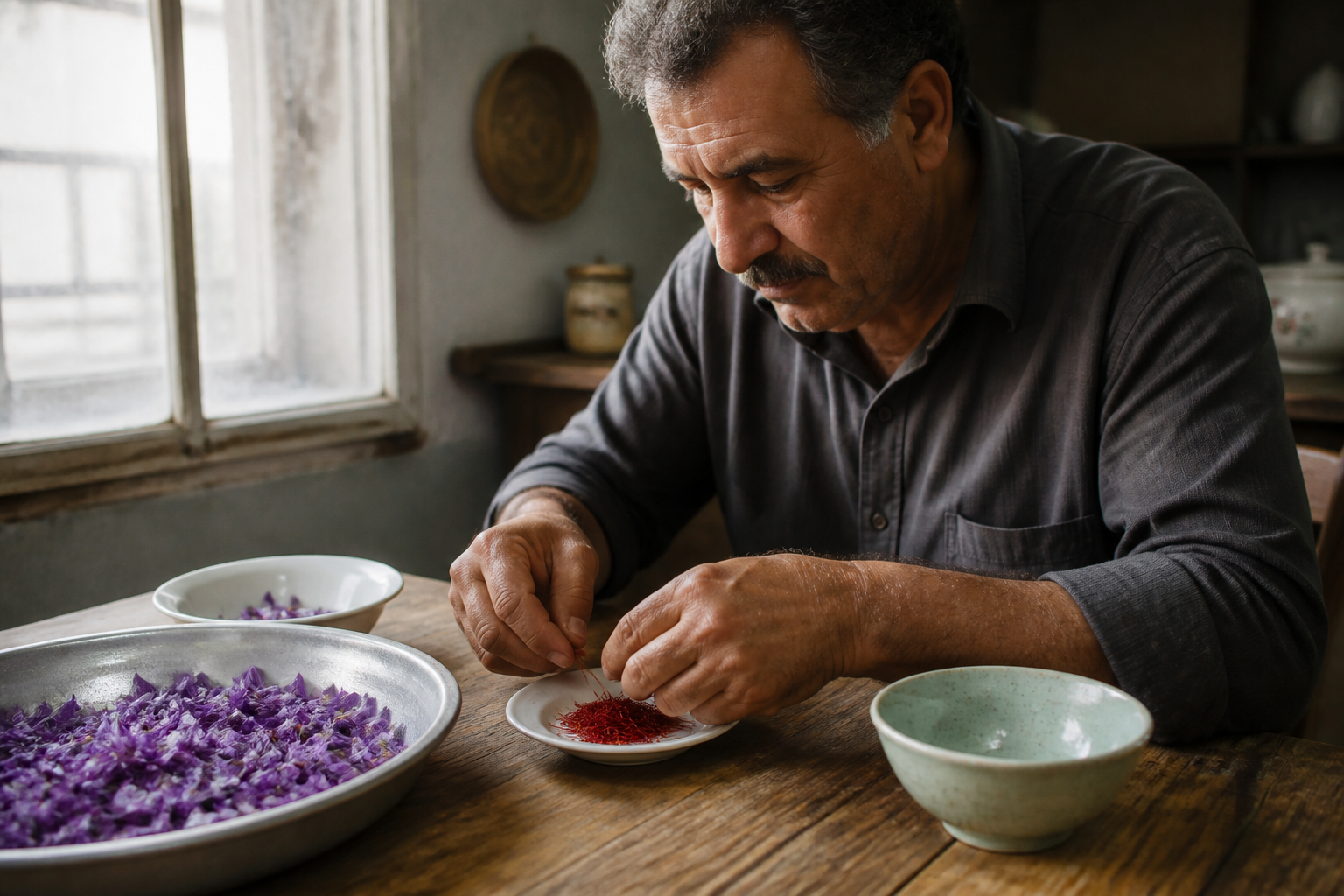
Nearly every saffron trial used the same dose: 30 mg per day of standardized extract, given as 15 mg twice daily. That figure comes from Iranian trials in adults with mild-to-moderate Alzheimer’s disease and from depression trials at the same dose; the branded affron® studies used 28 mg/day. There is no trial establishing a dose for healthy adults who want sharper thinking, because that trial has not been run.
We’re not recommending a product on this page. Start with the tier list — it shows which compounds have human trials behind them and which don’t.
See the tier list →The doses that appear in trials
Saffron has an unusually consistent dose across an unusually narrow literature. Everyone used 30 mg. Almost everyone ran the study in Iran.
| Study | Population | Daily dose | Duration | Outcome |
|---|---|---|---|---|
| Akhondzadeh et al. 2010, multicentre | Mild-to-moderate Alzheimer’s | 30 mg vs donepezil 10 mg | 22 weeks | Comparable on ADAS-Cog and CDR-SB; less vomiting |
| Akhondzadeh et al. 2010, placebo-controlled | Mild-to-moderate Alzheimer’s | 30 mg | 16 weeks | Better than placebo on ADAS-Cog |
| Ayati et al. 2020, systematic review | MCI and dementia | 30 mg typical | Varies | Supportive; small samples, one region |
| Ashrafi / Bagherzadeh 2022 | Alzheimer’s, added to donepezil | 30 mg | Not stated in our source | Reduced some inflammation and oxidative markers |
| Depression trials | Mild-to-moderate depression | 30 mg | Varies | Comparable to fluoxetine or imipramine in small trials |
Evidence tier: Moderate in mild-to-moderate Alzheimer’s and in depression, and Weak in healthy adults.
The donepezil comparison is the headline, and it deserves both halves of an honest description. A 22-week multicentre randomized trial found 30 mg of saffron comparable to 10 mg of donepezil — a prescription drug — on ADAS-Cog and CDR-SB, with less vomiting.1 That is a striking result for a spice extract. It has also never been independently replicated outside Iran, and until it is, a single research lineage is carrying the entire finding. Both of those sentences are true and neither cancels the other.
The 2020 systematic review reached a supportive conclusion while flagging exactly this: small samples and geographic concentration.2 That is what a careful reviewer says when the effect looks real but the evidence base is thin in a specific, fixable way.
What that means for a healthy adult
Bluntly: the trials were not in healthy adults, so 30 mg is not “the saffron dose for focus.” It is the dose that was tested in Iranian adults with diagnosed Alzheimer’s disease, and separately in adults with mild-to-moderate depression.
Saffron’s mood file is arguably stronger than its cognitive one. Small trials found it comparable to fluoxetine or imipramine in mild-to-moderate depression. That is interesting, and it is also the point at which this page has to be careful: saffron is not a substitute for an antidepressant, nobody has tested it as a replacement in anyone already stable on one, and stopping a prescribed medication is not a decision a supplement page gets to influence. If your fog has a mood component, that belongs in a clinician’s office — and our page on nootropics and antidepressants covers what stacking actually involves.
If your reason for reading this is persistent fog with no obvious cause, the more useful reading is brain fog when your bloodwork comes back normal, and the tier list at do nootropics actually work.
Why the dose on your bottle is probably different
Saffron is the one ingredient in this category where the bigger problem is not the milligram figure — it is whether the powder in the capsule is saffron at all.
- Standardization is the number that matters. Trials used standardized extract, characterized by its actives — crocin, crocetin, safranal and picrocrocin. “Saffron 30 mg” with no standardization statement is not the same input the trials used.
- Extract is not stigma powder. Some products list ground saffron stigma by weight, which is a different material at a different active concentration. A milligram figure only means something once you know which one you are counting.
- Branded extracts have their own doses. affron® studies used 28 mg/day rather than 30. Close enough in practice, but worth knowing why the numbers differ.
- Blends usually underdose it. Saffron is one of the most expensive food ingredients on earth. When it appears inside a nine-botanical formula at an undisclosed amount, the economics tell you roughly what the amount is. See proprietary blends.
Adulteration is the real quality problem
Saffron is one of the most economically adulterated commodities in the world. Safflower, turmeric and dyed corn silk are common substitutes, and they are cheap enough that the incentive never goes away. This is not a niche concern that applies to bad actors only — it is the baseline condition of the saffron supply chain.
The practical consequence is that third-party testing matters more for saffron than for almost anything else on this site. Identity testing — confirming the material is what the label says — is doing more work here than potency testing. Our guide to what NSF, USP and Informed Choice actually certify explains which marks cover identity and which only cover contaminants.
Safety ceiling and who should not take this
At 30 mg a day, saffron is well tolerated. Reported effects are nausea, appetite change, headache and dry mouth. The dose ceiling is the unusual part, and it is worth stating precisely once so it is neither ignored nor exaggerated.
Saffron is toxic at gram-level doses. Around 5 g or more can cause serious toxicity, and roughly 12–20 g is potentially lethal. Supplement doses are 30 milligrams — several hundred times below that threshold — so this is a ceiling to know about rather than a risk you are running at label doses. It matters because it means “more is better” reasoning is actively dangerous with this particular ingredient.
⚠️ Talk to your prescriber first
Pregnancy. Saffron is an abortifacient at high doses and is contraindicated in pregnancy. This is the one entry here that is a straightforward avoid.
Anticoagulants and antiplatelets. Saffron has antiplatelet activity — caution with warfarin, DOACs, aspirin and clopidogrel. Anyone on an anticoagulant should clear any supplement with their prescriber, and botanicals should generally stop at least two weeks before surgery. See cognitive supplements to stop before surgery.
SSRIs, SNRIs and MAOIs. Saffron has serotonergic activity, so there is a theoretical additive risk. The evidence for a real-world problem is thin; the caution is standard and the conversation is a short one.
Blood pressure medication. Saffron may lower blood pressure, which is additive with antihypertensives.
What we don’t know
Whether the donepezil-comparison result holds outside Iran, which is the single largest open question about this ingredient. Whether 30 mg is the right dose or simply the first dose anyone tried and everyone copied — no dose-ranging study has been published. Whether saffron does anything measurable in healthy adults, at any dose, on any cognitive endpoint. And whether the cognitive results are downstream of the mood results, since the two literatures overlap heavily and depression affects cognitive testing.
What would change our mind
A multicentre randomized trial run outside Iran, by a group with no connection to the original investigators, using a characterized standardized extract at 30 mg/day against an active comparator, with a pre-registered ADAS-Cog primary endpoint. Independent replication is the only missing ingredient in saffron’s file — the effect sizes are already there, the standardization is already there, the safety data are already there. One well-run European or North American replication would move saffron from “interesting and unreplicated” to one of the better-supported botanicals in this reference. A well-run failed replication would do the opposite, just as decisively.
Frequently asked questions
How much saffron did the studies use?
30 mg per day of standardized extract, split as 15 mg twice daily, in nearly every trial. The branded affron® studies used 28 mg/day.
Is 30 mg of saffron safe?
It was well tolerated across the trials, with nausea, appetite change, headache and dry mouth reported. Toxicity is a gram-level concern — around 5 g and above — which is several hundred times the supplement dose.
Can I take saffron with an antidepressant?
Ask your prescriber before you do. Saffron is serotonergic, so there is a theoretical additive concern with SSRIs, SNRIs and MAOIs. It is not a substitute for a prescribed antidepressant and should never be used as one.
How do I know my saffron supplement is real saffron?
You can’t tell from the capsule. Look for a standardized extract with named actives and identity testing by an independent lab. Adulteration with safflower, turmeric and dyed corn silk is common enough to assume by default.
How long did the trials run?
16 to 22 weeks in the Alzheimer’s trials. Nothing in this literature reports a result from a few days.
Related reading
- Do nootropics actually work? An honest tier list
- Nootropics and antidepressants: a compound-by-compound interaction guide
- NSF, USP and Informed Choice: what third-party testing actually certifies
- Cognitive supplements to stop before surgery
- Proprietary blends: the legal trick that hides underdosing
- Brain fog when your bloodwork comes back normal
Sources
These statements have not been evaluated by the Food and Drug Administration. Nothing here is intended to diagnose, treat, cure or prevent any disease.
This article is information, not medical advice. Talk to a doctor or pharmacist about your own situation, especially if you take prescription medication.