
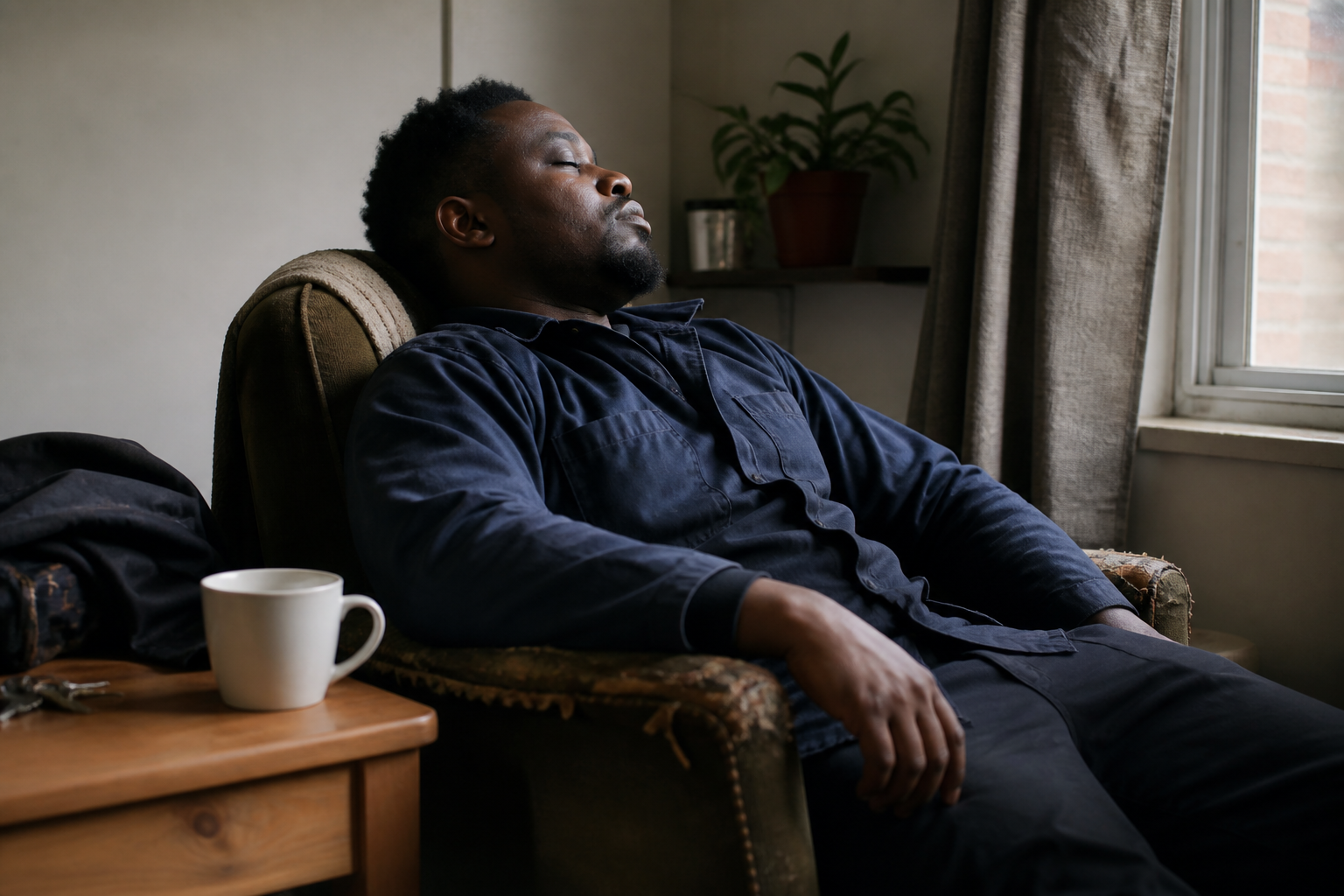
Drink about 200 mg of caffeine, then immediately lie down for 10 to 20 minutes. The caffeine has not taken effect yet — peak plasma levels arrive 15 to 120 minutes after ingestion — so the nap happens first and the alertness lands as you wake. In a driving-simulator study, caffeine plus a short nap reduced driving incidents to 9% of placebo levels, against 34% for caffeine alone. It is an alertness tool that works for a couple of hours. It does not consolidate memory, repay sleep debt, or substitute for a night’s sleep.
There is nothing to buy on this page, and there is no affiliate link on it. That is deliberate: the methods section of this site covers the interventions that actually have evidence behind them, most of which cost nothing, and a publication that only writes about the things it can sell is a catalogue.
How it works
Adenosine accumulates in the brain across a waking day and promotes sleep pressure. Caffeine crosses the blood-brain barrier easily and antagonises all four adenosine receptor subtypes, with A2a antagonism being the one most tied to wakefulness.1 It blocks the signal; it does not remove the adenosine.
Sleep is what actually clears adenosine. So the two interventions do different jobs: the nap reduces the signal, the caffeine blocks whatever signal is left. Stacking them is not folk wisdom about “the best of both” — it is two mechanisms acting on the same pathway from different ends.
The order is dictated by pharmacokinetics. Caffeine is absorbed fast — the Institute of Medicine’s review puts absorption at 99% within 45 minutes, with peak plasma concentrations between 15 and 120 minutes after oral ingestion and a mean plasma half-life around 5 hours, ranging from 1.5 to 9.5 hours depending on the person.2 StatPearls gives a similar picture: Tmax of roughly 30 minutes to 2 hours, half-life about 5 hours in adults, reduced by up to half in smokers and extended to as much as 15 hours in the third trimester of pregnancy.1
That 15-to-120-minute window is the whole trick. A short nap fits inside it. You fall asleep before the caffeine is doing anything, and you wake up as it arrives — which is also, conveniently, the moment when sleep inertia would otherwise be at its worst.
Sleep inertia is the second reason the combination works. Waking from sleep produces degraded alertness and performance that mostly resolves within 30 minutes but is not fully complete for at least an hour, and it is worse after longer naps, under accumulated sleep loss, and during the biological night. The 2019 review in Nature and Science of Sleep identifies caffeine consumed before sleep as the most effective proactive countermeasure to sleep inertia, and limiting naps to under 30 minutes as the main behavioural one.3 The caffeine nap does both at once.
How to actually do it — a worked example
It is 2:10pm. You slept six hours, you have a meeting at 4pm that requires you to be coherent, and the next ninety minutes are the worst of your day. Here is the protocol, timed.
2:10pm — drink 200 mg of caffeine, quickly. That is roughly a large brewed coffee or two shots of espresso, and it is half of the 400 mg per day that the FDA describes as not generally associated with negative effects in healthy adults.4 Drink it in a few minutes rather than sipping it over twenty. The point is to start the absorption clock now. If it is hot, let it cool first — you are not going to fall asleep in five minutes with a scalding cup.
2:15pm — set an alarm for 20 minutes and lie down. Twenty minutes is the outer limit, not the target. In a controlled comparison of 5-, 10-, 20- and 30-minute afternoon naps in 24 adults after restricted nocturnal sleep, the 10-minute nap was the most effective duration tested: immediate improvement across every outcome measure, lasting up to 155 minutes. The 5-minute nap produced few benefits, the 20-minute nap took 35 minutes to show benefits, and the 30-minute nap produced a period of impaired alertness immediately after waking before any improvement appeared.5 The alarm at 20 minutes is insurance against sliding into slow-wave sleep, not an instruction to use all of it.
2:15–2:30pm — it is fine if you don’t sleep. The original protocol study explicitly included naps consisting of “nonsleep dozing” and still found the effect.6 Lying still in a dark room with your eyes closed is doing most of the work. Do not spend the twenty minutes on your phone deciding whether the nap is working.
2:35pm — get up into light and movement. Stand, get bright light on your face, walk for two minutes. The caffeine is arriving; the inertia is clearing. Do not go straight back to the task that put you to sleep.
2:45pm to roughly 5pm — this is your window. Expect improved vigilance and reaction time, not improved learning. Put the meeting, the drive, or the proofreading here. Do not put your hardest new-material learning here and expect the caffeine to help you remember it: caffeine’s reliable effect is on alertness, not on memory formation.
The cost, paid later. A 200 mg dose at 2:10pm has a mean half-life of about five hours, so roughly 100 mg is still circulating at 7pm and 50 mg at midnight. A 2025 randomized crossover trial found that 400 mg taken four hours before bed reduced total sleep time by around 51 minutes, delayed sleep onset by about 14 minutes and reduced sleep quality by 34%, while 100 mg had no significant effect on sleep even four hours before bed.7 A single afternoon caffeine nap is not the problem. Doing it daily at 4pm is how you build the sleep debt the nap was compensating for.
What the evidence says
This is one of the better-evidenced protocols on this site, which is a low bar in this niche but a real one. The core finding has been replicated in a second lab with a different design.
| Study | Population | Intervention | Task | Outcome |
|---|---|---|---|---|
| Reyner & Horne 1997, Psychophysiology | Sleep-restricted adults | 200 mg caffeine + nap under 15 min vs caffeine alone vs placebo | 2-hour monotonous afternoon drive in a car simulator | Combination eliminated the mid-afternoon sleepiness peak and reduced driving incidents to 9% of placebo; caffeine alone reached 34% of placebo |
| Sagaspe et al. 2007, SLEEP | 12 adults aged 20–25 and 12 aged 40–50 | 200 mg caffeine vs 15 mg placebo vs 30-min nap | 125 miles of real highway night driving | Placebo condition: inappropriate line crossings rose from 2 to 73 (young) and 0 to 76 (middle-aged). Coffee cut crossings ~75% in the young and ~90% in the middle-aged; napping helped the young far more than the middle-aged |
| Brooks & Lack 2006, SLEEP | 24 healthy young adults, not habitual nappers | 5, 10, 20 or 30-minute nap vs no nap | Afternoon alertness and performance battery | 10-minute nap most effective; benefits up to 155 minutes; 30-minute nap produced measurable sleep inertia first |
| Hilditch & McHill 2019, Nat Sci Sleep | Review | Countermeasure comparison | Post-waking performance | Caffeine before sleep identified as the most effective proactive countermeasure; light showed limited effect on objective performance |
The Sagaspe result is the one that gets left out of most write-ups, and it is the most useful. The nap worked much better in 20–25-year-olds than in 40–50-year-olds — the younger group reached deeper sleep and slept longer during the nap opportunity.10 If you are in your forties and the nap half of this does nothing for you, that is a documented pattern, not a personal failure.
Community reports — not trial data
The caffeine nap circulates widely on productivity forums, usually with a specific dose and duration presented as optimal — 12 minutes, 175 mg, and so on. No study has tested that granularity. The trials used 200 mg and naps of under 15 to 30 minutes, and the sensible reading is that anything in that neighbourhood works. Precision beyond what was measured is invented.
Where it fails
- It does nothing for memory. Caffeine’s reliable effects are on vigilance and reaction time. Do not use it as a study aid on the theory that it improves learning. If you want the memory intervention, that is sleep consolidation, and it happens at night.
- It does not repay sleep debt. Caffeine blocks the adenosine signal; only sleep clears it. What you get is a functioning two to three hours, followed by the same deficit.
- In habitual users, part of the benefit is withdrawal reversal. Chronic caffeine use upregulates adenosine receptors in the CNS, and withdrawal symptoms can appear after as little as three days of exposure, beginning 12 to 24 hours after cessation, peaking between 20 and 51 hours and lasting 2 to 9 days.8 If you drink coffee daily, some of what you experience as a boost is return to your own baseline.
- The nap half works less well with age. See Sagaspe above.
- Overshoot the nap and you get inertia instead. A 30-minute nap in the Brooks and Lack comparison produced impaired alertness immediately after waking. Sleeping 45 minutes at 4pm will make the rest of your day worse, not better.
- It cannibalises the night if you do it late. See the dose-and-timing data above. This is a tool for early afternoon, not for 6pm.
⚠️ When to skip this entirely
Caffeine’s half-life extends to as much as 15 hours in the third trimester of pregnancy, so the same dose behaves very differently.1 If you are pregnant or breastfeeding, have a cardiac arrhythmia, an anxiety disorder, uncontrolled hypertension, or take any medication that interacts with caffeine — fluvoxamine is the clearest example, via CYP1A2 — ask a pharmacist before adopting this as a routine. And chronic daytime sleepiness that requires a protocol to manage is worth a clinical conversation about sleep apnea rather than a workaround. See brain fog red flags.
What would change our mind
A properly powered trial that separates the two components in the same sample — caffeine alone, nap alone, caffeine plus nap, and placebo plus rest — with a pre-registered analysis and enough participants to detect an interaction rather than a main effect. The 1997 study compared caffeine-plus-nap with caffeine alone, but the modern evidence base for the combination is thinner than the confidence with which it circulates. If a well-powered trial found the nap contributed nothing beyond caffeine, this page would become a page about caffeine timing.
Frequently asked questions
How much caffeine should I use?
The trials used 200 mg, which is roughly a large brewed coffee. FDA describes 400 mg a day as an amount not generally associated with negative effects in healthy adults, and notes wide individual variation in both sensitivity and clearance. If 200 mg makes you jittery, use less — the protocol depends on the timing, not on hitting a specific milligram figure.
What if I can’t fall asleep in 20 minutes?
It still works. The 1997 driving study counted nonsleep dozing as a nap and found the effect anyway. Lying still with your eyes closed in a dark room reduces sensory load and is most of the intervention. Trying hard to fall asleep is the one thing guaranteed to prevent it.
Is 3pm too late?
Probably not for a one-off; it becomes a problem as a habit. With a five-hour mean half-life, a 200 mg dose at 3pm leaves roughly 50 mg on board at 1am. The 2025 crossover trial found 100 mg four hours before bed did not significantly disrupt sleep, so a single mid-afternoon dose is unlikely to wreck the night — but the closer to bedtime and the higher the dose, the worse it gets.
Can I do this every day?
You can, and it is a signal worth listening to if you need to. Daily use builds tolerance through adenosine receptor upregulation, which means the same dose does less and skipping it does more. If the caffeine nap has become structural rather than occasional, the underlying question is why you are chronically short of sleep — the AASM and Sleep Research Society recommend seven or more hours per night for adults on a regular basis.9
Does it work for night shift?
Sleep inertia is worse during the biological night, which is exactly when a night-shift nap happens, so the caffeine half becomes more important and the nap half riskier. The Sagaspe trial was run on real night driving and both interventions helped. We cover the wider problem at night shift brain fog.
Related reading
- The 3pm crash: why afternoon brain fog happens
- Morning brain fog and sleep inertia
- Night shift brain fog and circadian misalignment
- Sleep debt and brain fog: what recovers and what doesn’t
- L-theanine with stimulant medication: what the evidence supports
Sources
- Caffeine. StatPearls, NCBI Bookshelf
- Pharmacology of Caffeine. In: Caffeine for the Sustainment of Mental Task Performance. Institute of Medicine, National Academies Press, 2001
- Hilditch CJ, McHill AW. Sleep inertia: current insights. Nature and Science of Sleep 2019;11:155–165
- Spilling the Beans: How Much Caffeine is Too Much? US Food and Drug Administration
- Brooks A, Lack L. A brief afternoon nap following nocturnal sleep restriction: which nap duration is most recuperative? SLEEP 2006;29(6):831–840
- Reyner LA, Horne JA. Suppression of sleepiness in drivers: combination of caffeine with a short nap. Psychophysiology 1997
- Gardiner CL, Weakley J, Burke LM, et al. Dose and timing effects of caffeine on subsequent sleep: a randomized clinical crossover trial. SLEEP 2025;48(4)
- Rocha Cabrero F, Hamilton RJ. Caffeine Withdrawal. StatPearls, NCBI Bookshelf
- Watson NF, Badr MS, Belenky G, et al. Recommended amount of sleep for a healthy adult: a joint consensus statement of the AASM and Sleep Research Society. Journal of Clinical Sleep Medicine 2015;11(6):591–592
- Sagaspe P, Taillard J, Chaumet G, et al. Aging and nocturnal driving: better with coffee or a nap? A randomized study. SLEEP 2007;30(12):1808–1813
These statements have not been evaluated by the Food and Drug Administration. Nothing here is intended to diagnose, treat, cure or prevent any disease.
This article is information, not medical advice. Talk to a doctor or pharmacist about your own situation, especially if you take prescription medication.